.svg)


As LLMs mature and the model providers seek a return on their investment following huge spending on datacentres, it’s inevitable that the price of service for users was going to increase. We’ve already seen Anthropic try to remove Claude Code from their basic Pro plan because the traditional subscription model of “most people won’t max this out” (which used to work when there was a human in the loop) breaks down when agents are increasingly working autonomously or being driven by Ralph Loops.
Now it’s GitHub’s turn. Instead of a subscription that allows use of a set of features, the subscription becomes only a token allocation. Let’s take a look.
What's changing
Starting June 1, 2026, GitHub Copilot replaces premium request units (PRUs) with GitHub AI Credits. Usage is metered by token consumption, covering input, output, and cached tokens at published per-model rates, where one AI credit equals $0.01.
Credits come from a single pool, and almost every Copilot feature draws from it: Copilot Chat, the Copilot CLI, the cloud agent, Spaces, Spark, third-party coding agents, and Copilot code review. There is no per-feature budget. Code review pulls from the same credits as everything else, and the pool is shared across your whole organization rather than split into per-seat buckets. On the one hand, this allows more flexibility, so that under-users can have their spare tokens used up. However, this means that, when you run out across the org, almost everything stops.
Only the most basic human-interactive stuff remains unlimited (code completions and Next Edit Suggestions) even when the credit pool is depleted.
For Copilot Code Review in particular, there is a sting in the tail: token consumption is billed in AI Credits, and the agentic infrastructure that runs the review consumes GitHub Actions minutes, charged for private repositories at standard Actions rates. This is the same as their other Action-triggered agent pricing. These are separate line items. Actions minutes do not draw down AI Credits, and AI Credits do not cover Actions minutes. Both show up on the same bill.
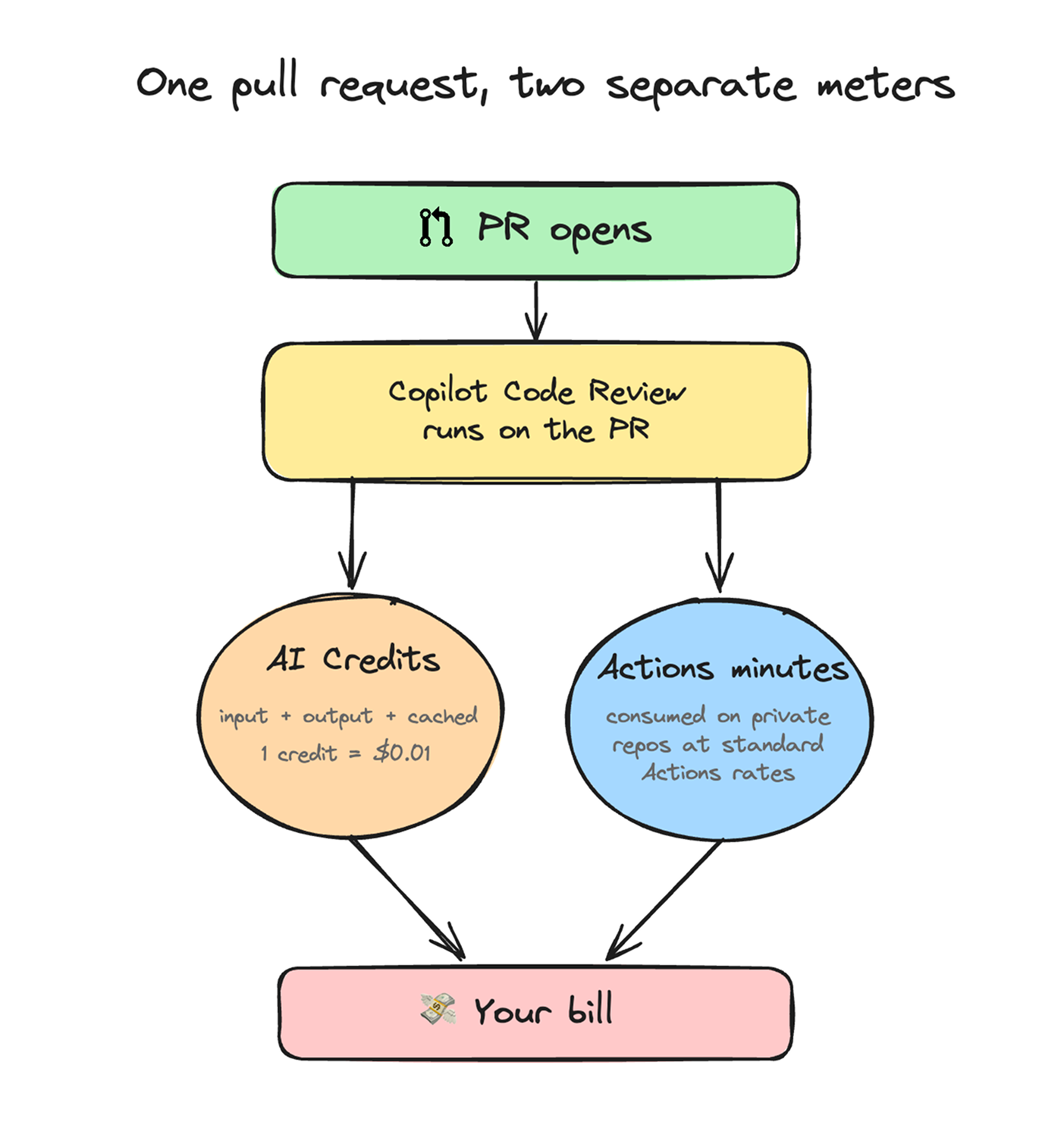
For an existing Copilot Business customer, the included allotment is 3,000 AI credits per user per month from June 1 to September 1, 2026. That is a promotional rate; it drops to 1,900 credits per user per month after September 1.
One more change. When the pool and any overage budget are spent, there is no fallback to a cheaper model. Under PRUs, Copilot dropped to a lower-cost model once the budget ran out. That behavior is being removed. Once credits are gone, chat, agents, and code review stop entirely until the entitlement resets, or you buy more.
Hnnnnnnnnnnng
This sort of hard-stop usage-based billing can be, of course, infuriating! In a large organization where additional cost approval is not straightforward, that could mean the entire department locking down for days until the approval is acquired and the limits cranked.
Additionally, token-based billing while the norm with AI products is entirely unpredictable. If the CTO (hey that’s me!) decides to go on a weekend bender of multi-agent programming, suddenly everyone stops unless you put your hand in your pocket. Or you need to go set usage limits per-individual into GitHub, which is essentially the same system as before for pricing but now you have to manage it yourself.
For GitHub Copilot Code Review specifically, the cost of the review is unknowable in advance, since it’s governed by both input and output tokens, and also how much time the model thinks for is also both uncontrollable and billed to you. The model in use is not disclosed, so you can’t even do some finger-in-the-air maths on it.
The shared pool makes this worse. Code review has no protected budget. It competes for the same org-wide credits as every chat session, every agent run, and every CLI invocation. A few engineers running heavy agentic sessions on frontier models can draw down credits that would otherwise have covered code reviews for the rest of the team. With no cheap-model fallback, a pool that empties mid-month means code review stops until the next cycle. Usage-based billing has not started yet, so this is a forward-looking risk rather than a measured outcome. It is a structural one, written into how the pool works.
The reaction from developers has been skeptical. GitHub's own announcement drew 37 downvote reactions and a handful of "confused" reactions, with almost no positive ones. Visual Studio Magazine summarized the mood in a headline: "You Will Get Less, but Pay the Same Price." IT Pro noted that GitHub's FAQ concedes users with intense agentic usage will likely see costs increase.
What’s The Alternative?
Copilot code review is the default standard for AI code review, and, until now, it was a bit of a no-brainer: built into GitHub, one-click to enable, and leaves useful inline comments. For a small team that values that native convenience over total cost and price predictability, it could be a good choice.
But this is no longer a “free” feature included in the product – now you’re paying for it.
There’s another tool (aha!) that includes unlimited AI code reviews with your regular subscription that gives you more than the pure GitHub Copilot review experience: Codacy combines deep and wide static analysis for quality and security beyond what GitHub Copilot Code Review supplies at a fixed price per-seat.
Start with the price, since that is the line a CTO has to forecast. Codacy plans start at $18 per developer per month, billed annually. It is a flat per-seat cost, with no usage meter and no GitHub Actions minutes consumed. Code review becomes a number that does not move when your team merges more pull requests.
The review itself is built differently. The Codacy AI Reviewer combines rule-based static analysis with AI-assisted reasoning, and draws context from the full pull request: the diff, related source files, PR metadata, and optionally the linked Jira ticket. It checks whether the stated intent of the PR matches what the code does, flagging business logic gaps, missing tests for critical functions, complexity, duplication, and security issues with remediation guidance.
It also catches issues before a review is requested. Codacy's IDE extension for VS Code, JetBrains, and Cursor, which bundles the Codacy CLI and an MCP server, gives in-line feedback for human-written code, and scans AI code as it is being generated and fixes it before the developer even sees it in the editor. That scan runs locally and deterministically, so cleaner code reaches the pull request, without consuming any tokens for the analysis. With Copilot, the agent mode and CLI usage that produces the code is itself drawing down the credit pool.
The subscription also covers work a diff-based reviewer does not do at all. On every pull request, the Team plan adds dependency and software composition analysis, malicious-package detection, infrastructure-as-code checks, and test-coverage gates that can block a merge, across 49 languages. It scans the full codebase from the moment repositories connect, not only the open diff. The Business plan adds org-wide AI code governance: daily SCA rescans against new CVEs, an AI model and tool inventory, and AI coding policy enforcement.
|
Copilot Code Review |
Codacy |
|
|---|---|---|
|
Pricing |
AI Credits (token-metered) + GitHub Actions minutes |
Flat per seat, starting at $18/dev/mo |
|
Cost predictability |
Per-review cost undisclosed and variable |
Fixed per seat, no metering |
|
GitHub Actions minutes |
Consumed on private repositories |
None consumed |
|
At budget exhaustion |
Review stops; no cheap-model fallback |
Not metered; nothing to exhaust |
|
Pre-review checks |
Not part of code review |
Scan-as-you-type feedback + auto-fix AI code during generation |
|
SAST, SCA, Malicious Packages, IaC |
Not part of code review (separate GitHub-native or third-party tools needed) |
Included on every pull request |
|
Test-coverage merge gates |
Not part of code review (separate third-party tools needed) |
Included |
|
Analysis scope |
Open pull requests only |
Full codebase from connection, plus per-PR review |
|
Org-wide AI code governance |
Not covered |
AI Inventory and policy enforcement (Business plan) |
How to switch to Codacy’s AI Reviewer
The migration is low-friction and can be done across multiple repositories at once.
Turn off Copilot code review at the organization level. In your GitHub organization settings, open the Copilot settings and toggle off automatic code review. The disabling can be inconsistent on the first push, so watch three or four pull requests land without a review before rolling it out org-wide.
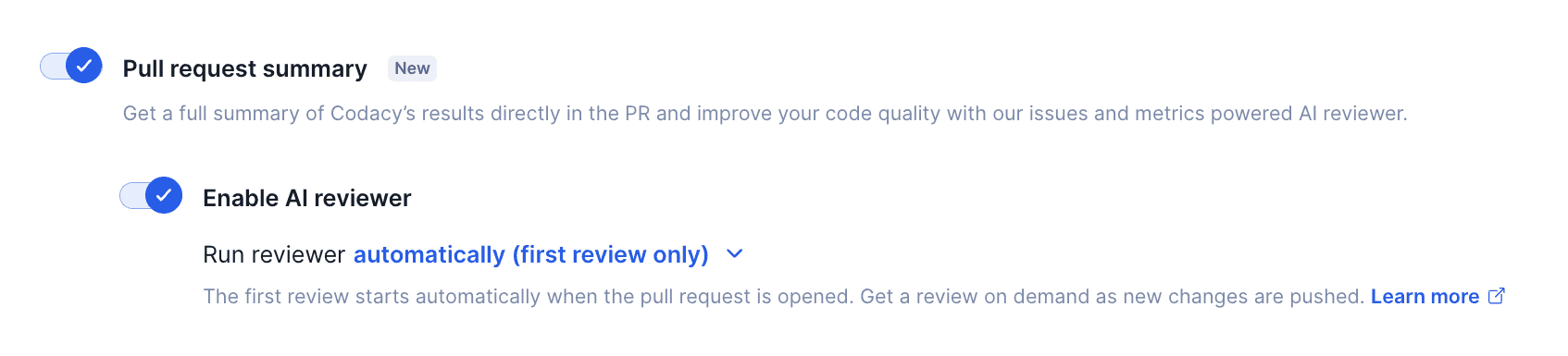
Turn on the Codacy AI Reviewer. If you are already on a Codacy Team or Business plan, open your organization settings in Codacy, go to Integrations, find 'Enable AI reviewer' under Pull request summary, and toggle it on. If you are new to Codacy, connect your GitHub account and repos, and Codacy runs a full scan of the codebase and open Pull Requests immediately. The 14-day trial needs no credit card. Once enabled, a Run Reviewer control appears on your pull requests, and you can set it to run automatically when a PR opens.
If you want the reviewer aligned to your codebase from day one, add a review.md file under .codacy/instructions/ describing your architecture, conventions, and what to prioritize. Check our example prompt to quickly generate your review.md file from scratch.
To put the pre-review layer in place, have developers install the Codacy extension in VS Code, JetBrains, or Cursor. It carries the Codacy Analysis CLI and an MCP server, so AI-generated code is checked and fixed in the editor before it reaches a pull request.
Predictable code review, starting today
The June 1 change does not raise Copilot's sticker price. It changes what the sticker price covers, and it turns code review into a metered cost that competes with every other agentic feature for the same credits. For a CTO who has to forecast a budget, an unpredictable line item is a problem, whether or not it turns out to be expensive.
Codacy makes that line predictable, and pairs the review with the security scanning, coverage gates, and trend visibility that Copilot was never built to provide.
Start a free 14-day trial at codacy.com/sign-up. No credit card required, full scan within minutes. Running a team of 10 devs or more? Book a demo and we'll walk through your setup.
Try Codacy's AI Reviewer today
Start your free 14-day trial and add your projects with a few clicks. No credit card required, full scan within minutes.