.svg)
AI Giants Recap: Why the Real Competitor to Vercel’s v0 Is Microsoft Word

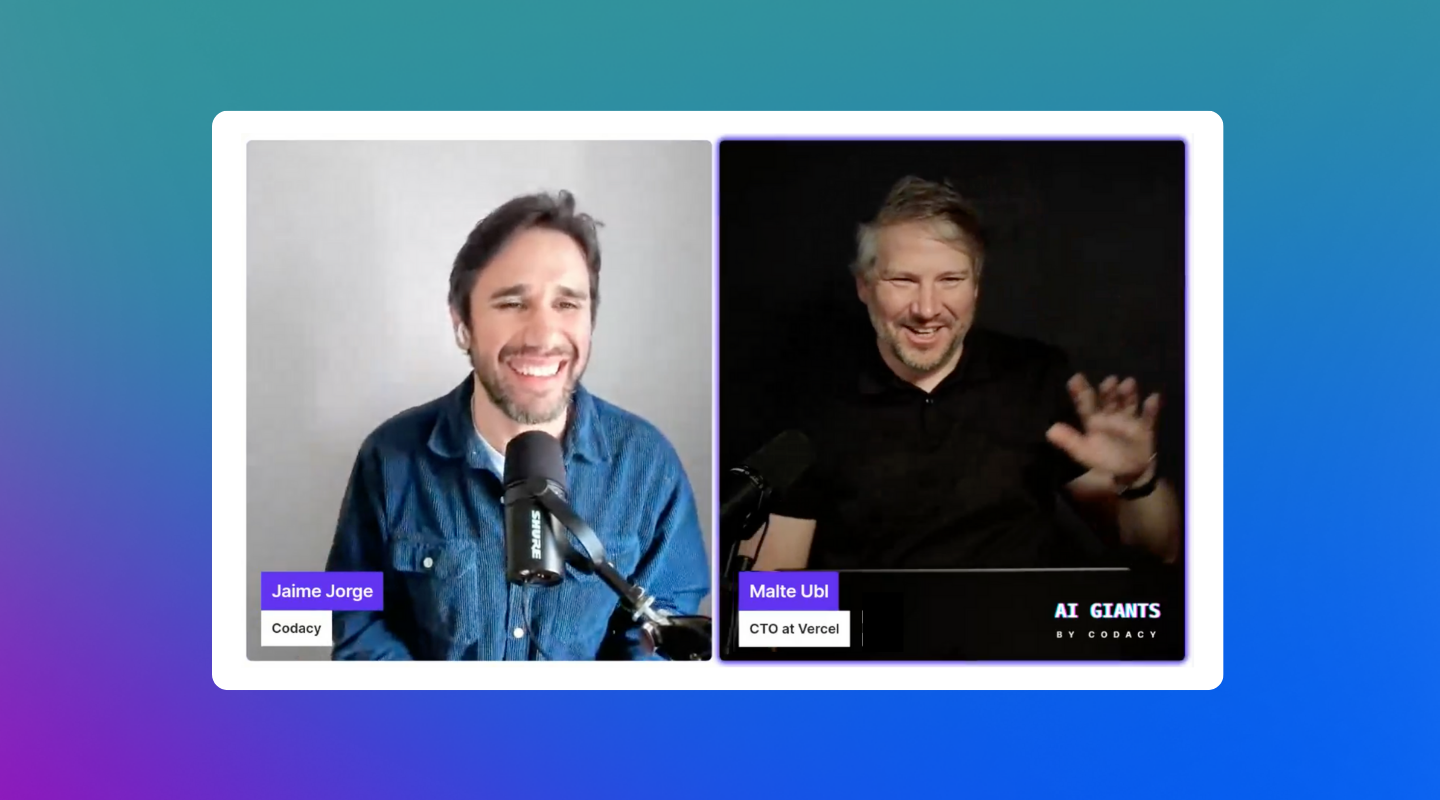
When Vercel's team first tried getting AI to generate websites, the results were garbage. Then someone had a breakthrough. "Guys. I have it. I told it to use Tailwind."
That's how Malte Ubl, Vercel's CTO and former Google principal engineer, describes the moment that kicked off the prompt-to-product era. In this episode of AI Giants, Codacy CEO Jaime Jorge sat down with Ubl to dig into what Vercel learned from four product pivots, why build time is the only metric that matters, and what he thinks about developers who worry AI will take their jobs.
What is Vercel?
Vercel is best known for shaping the modern React ecosystem. It maintains Next.js, builds tools like v0, and provides the infrastructure many teams use to develop and run React applications in production. But Vercel is more than the hosting layer; it influences how frontend teams think about iteration, previews, and the boundary between writing UI code and shipping it to the web.
TLDR; What Engineering Leaders Can Learn
- v0's real competitor isn't Cursor or other coding agents. It's Microsoft Word and the PRD-to-developer handoff.
- Build time is the only productivity metric that actually changes behavior. At thirty seconds, you wait. At ten minutes, you context-switch.
- Being opinionated works for mature technology like web frameworks. It backfires for emerging tech like AI agents.
- Juniors aren't the ones who should worry about AI. Senior developers who are set in their ways are more at risk.
- Vercel doesn't train on code deployed to their platform. v0 customers can opt into zero data retention.
- Open source sustainability comes from growing the pie, not protecting your slice.
The 4 v0 Pivots Weren't Pivots at All
v0 went through four fundamental rethinks before and after launch. But Ubl pushes back on calling them pivots in the traditional startup sense.
"None of these pivots were painful," he says. "We never pivoted in the sense of 'damn, this isn't working.' The real pivots came from the technical capabilities of frontier models advancing."
Before Sonnet 3.5, AI coding tools were limited to prototyping or generating specific React components. Full-stack apps weren't possible. Then suddenly, they were. "You could connect to Postgres, run cron jobs, all the things you need in a full application became possible." The recent release of Opus 4.5 is creating another similar step change.
v0's Actual Competition Isn't Cursor
Ubl's spiciest take is that v0's main competitor isn't other coding assistants. It's Microsoft Word.
"You're writing this PRD or whatever you call it, 'this is what I want,' then you throw it over the fence to a developer. They come back six weeks later and say, 'Actually, you misunderstood me."
v0 is targeting tech-adjacent folks like product managers, designers, and product owners who can now show up with a working app instead of a document. The other big focus is internal tools. Apps that used to sit in a three-year roadmap backlog can now be built immediately.
On Dax's Take About Opinionated Frameworks
In our previous podcast with Dax Raad of OpenCode, Dax argued that tools for developers at scale can't be opinionated. You have to meet people where they are. Ubl's response is that it depends on the maturity cycle.
"He's not completely wrong, but he misses a very important nuance," Ubl says. Web frameworks have been around for decades. "We understand really well how to build a web application."
Agent development? Completely different story. "Nobody knows how to build agents. In the last three months, there's been an industry-wide reckoning that coding agent architecture works super well for non-coding tasks."
That's why AI SDK and Next.js have opposite philosophies. Next.js is opinionated because web development is mature. AI SDK gives you functions and examples because the space is still figuring itself out.
The One Metric Vercel Actually Cares About
When asked how Vercel knows customers are genuinely more productive and not just feeling like they are, Ubl's answer is simple. Build time.
"Build time. It's the most objective thing. It's a very different life if it's thirty seconds, two minutes, ten minutes, or thirty minutes."
At 30 seconds, you'll actually wait for the preview deployment and send it to a colleague via Slack. At ten minutes, you context-switch to something else and maybe forget to come back. The compound effect matters.
"We also want to see that customers make more builds. If you have 100,000 customers and they all make more builds, that's a strong signal."
React Server Components and Lessons Learned
The RSC rollout had its bumps. Some developers felt guilty about using "use client," which Ubl finds absurd.
"Like, why? If you want to make the thing interactive, you have to put it in. It's fine."
The bigger lesson is that App Router doesn't answer everything in an application lifecycle. "Developers need to understand that you're going to use React Query in your App Router app. App Router doesn't give you another way of real-time updating data, and that's cool."
On Vercel being "too close" to React core, Ubl points out that Meta is the first major contributor and Vercel is the second. "That must be better than having a single one, a single one that doesn't really care. If you've ever heard Mark Zuckerberg list Meta's proud open source contributions, have you ever heard him say React? No. He says Llama."
Junior Devs Aren't the Ones Who Should Worry About AI
The conventional wisdom says AI threatens junior developers. Ubl flips it.
"The person who needs to be worried is someone who's five-plus years into their job and set in their ways."
Vercel has a big internship program. "They're amazing. They give devs who work here full-time a run for their money." The company has zero plans to stop hiring at junior levels.
What's actually happening is that the strongest AI adoption is at the most senior levels, among principal engineers. "There's a good intuition for why. They've been reviewing so much code. That's more of their job now than it used to be."
On Open Source Sustainability
The sustainable open source debate isn't new, but AI is accelerating it. Ubl points to Vercel's model of completely unencumbered licenses. They love it when people make services selling Next.js hosting.
"We've discovered it's better to grow the pie than to say all the pie is ours. That limits the size."
Other options are emerging, like paid skills that go with open source libraries. But the core principle holds. Growing the ecosystem beats protecting a smaller slice.
Will AI Costs Skyrocket?
A YouTube viewer asked whether AI costs will eventually make tools like v0 unaffordable. Ubl's not worried.
"This is computers doing work. We as a species are extremely good at making computers better."
The bigger picture is that with multiple AI labs competing head-to-head, market dynamics push costs down. "Sure, maybe Opus is the best model right now, but Gemini is gonna catch up. OpenAI is gonna catch up. I can switch over."
The Takeaway
Ubl's mantra for Vercel is that iteration velocity solves all known problems.
It's not just about moving fast. Velocity is a vector, so direction matters as much as speed. That's what Vercel builds for themselves and wants to give their customers. The ability to iterate and adjust direction at any moment.
Software, in this framing, is just a side effect.
Codacy Helps You Ship Secure AI-Generated Code
Whether you're using v0, Cursor, Copilot, or any other AI coding tool, the code still needs to be clean and secure before it hits production. Codacy Guardrails scans AI-generated code in real time as it's being written, catching SAST vulnerabilities, hardcoded secrets, and insecure dependencies before they ever reach your repo.
Learn how Codacy Guardrails can protect your AI-accelerated development workflow at codacy.com
AI Giants is Codacy's podcast series featuring conversations with leaders building the future of AI coding. Watch the full episode with Malte Ubl on YouTube.