.svg)

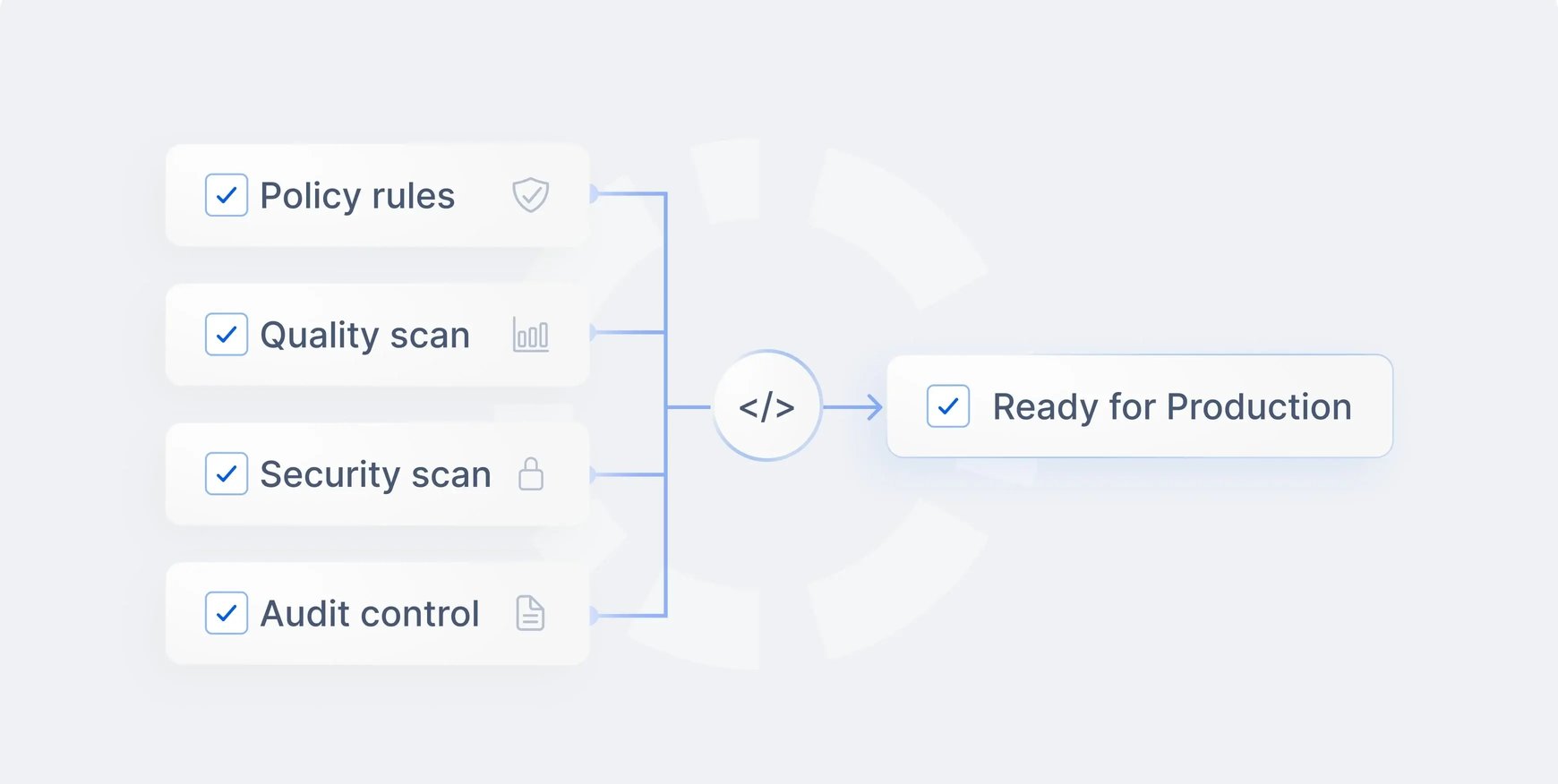
With 51% of professional engineers using AI in their daily work, agentic workflows are redefining how software development progresses from generation to deployment.
While agentic AI automation is at the forefront of a new wave of development practices, what doesn’t change automatically is verification. In this context, verification refers to the broader enforcement layer that includes quality gates, policy checks, and acceptance logic applied consistently across changes. Code production is now becoming increasingly agent-driven, but validation is still fragmented and probabilistic, often dependent on the same production models generating the code.
In agentic environments, verification is more than a single quality gate at the end of development. It emerges as a coordination layer that allows multiple agents to operate against the same standards.
While control used to sit with the engineer writing the code, it now sits with the set of automated checks that determine whether a change is allowed to merge. This means that, in agentic workflows, the question is no longer who wrote the code, but what allowed it to pass those checks.
The verification gap: Why coding agents need quality gates
Coding agents operate as a multi-step system: planning, decomposition, implementation, and iterative refinement throughout multiple files and commits. And more steps throughout the process mean more surface area for errors to slip through.
The failure modes are multiple. AI agent reliance may primarily cause problems that are inherently hard to detect.
- Step-by-step drift: When a plan ideated by a coding agent is structurally unsound (which might manifest as incorrect data flows, missing edge cases, or invalid assumptions about system boundaries) any implementation following it faithfully will result in internally consistent yet wrong results. This scenario can happen, of course, even if the architecture at the root is created by a human engineer. AI agents are faithful to the given specifications and plans, causing errors to slip through the cracks.
- Probabilistic validation: Even prompting an ad-hoc AI review may produce inconsistent results. Language models are not reliably calibrated to assess their own correctness, which means that they can be confident and wrong, or uncertain and correct. In practice, this makes AI-based reviews useful for surfacing issues, but insufficient as a stable acceptance mechanism on their own.
- No enforcement point: Checks do exist in CI pipelines, linters, security scanners, and pull request reviews. But they are implemented as independent checks that each evaluate a different aspect of the change. Even when combined into branch protection rules, they remain a collection of signals rather than a single unified evaluation layer with shared context and decision logic.
A lack of a single authoritative enforcement layer causes agentic systems to risk propagating errors during the codebase generation process. These then end up causing bottlenecks at best, and, at worst, you see them in production for the first time.
These failure modes are not only theoretical. Even large engineering organizations are beginning to adapt governance structures as AI-generated code becomes increasingly common in production. In early 2026, Microsoft introduced a dedicated engineering quality leadership role less than a year after stating that roughly 30% of its internal code was AI-generated. The move coincided with growing scrutiny around reliability and patch quality across major software releases.
The broader signal is structural: as code generation accelerates, verification becomes a governance problem rather than an individual reviewer’s responsibility.
See where AI-generated changes are breaking your quality gates
AI-generated and human-written code can behave unpredictably at scale. Codacy helps reveal where enforcement breaks across your engineering system.
Probabilistic vs deterministic validation: Why “AI reviewing AI” is not enough
A common approach today is to use the same or similar AI models to review generated code, often through prompt-based “review passes” or secondary agent calls.
These “AI-assisted reviews” usually mean one of two things:
- The same model that generated the code is prompted to review it
- A second model evaluates the output in a follow-up pass
These systems are best understood as heuristic reviewers rather than enforcement mechanisms: they provide additional context, but do not operate against fixed acceptance criteria or shared policy enforcement logic.
They are useful for summarization and surface-level issue detection, but they are not deterministic, which means the same change can receive different evaluations across runs.
While this approach might be functional for brainstorming or even local testing environments, system-level guarantees, such as those expected in production environments, cannot be based on probabilistic systems alone.
First-level reviews and checks have wiggle room for probabilistic approaches. Enforcement cannot.
This distinction becomes critical in regulated environments. While not concerned directly with how code is reviewed, compliance frameworks like SOC 2, ISO 27001, HIPAA, and increasingly ISO/IEC 42001 are focused on whether controls are consistent as well as auditable. In practice, this, too, requires deterministic enforcement: the same input is supposed to always produce the same decision under the same policy conditions. Probabilistic systems, on the other hand, can support this process, but cannot serve as the sole enforcement layer for production-bound changes.
The missing layer: Independent verification as an independent enforcement system
In traditional workflows, review happens right after implementation. In agentic workflows, however, generation becomes continuous, parallel, and distributed between multiple systems. Rather than producing code, the challenge is coordinating and validating an increasing volume of changes. This way, verification becomes the mechanism that keeps those changes aligned to a shared standard.
A proper verification layer lies between generation and acceptance, ensuring every change is evaluated against consistent rules before it is merged. It evaluates every change as a diff, runs deterministic checks (static analysis, security rules, and test execution), and returns a single pass/fail decision against a defined standard. In practice, this means the system is evaluating a specific change against explicit rules at a defined point in the workflow, rather than “reviewing code” in the abstract. In environments where multiple agents may plan, implement, review, and revise changes independently, verification acts as a coordination layer. It makes sure that all outputs are evaluated against the same rules, regardless of which model produced them.
The three main properties of a reliable verification layer within agentic workflows are as follows:
-
Independent: A reliable AI verification is one that is carried out by a system different from the one that generated the code.
-
Deterministic where it matters: Clear pass/fail conditions are needed so that security rules, quality thresholds, and policy enforcement might be upheld.
-
Context-aware when needed: Within defined boundaries, AI can be used to interpret intent; for example, verifying that a change actually implements the original request.
AI agents are great for code generation, but the same system that generates your engineers’ code should not be the one to review it, too. A deterministic enforcement is required. As generation becomes faster and more autonomous, the bottleneck shifts away from implementation and toward validation. Engineering teams are no longer constrained by how quickly code can be written, but rather by how reliably changes can be evaluated before they compound across the system.
The deterministic stack
A stable agentic workflow relies on a compounded solution that involves both a deterministic layer and an AI-assisted interpretation layer that come together into a hybrid model.
Deterministic verification and AI reasoning solve different problems. One enforces standards, while the other helps interpret ambiguity and context. Together, they create a model that supports agentic development on all fronts and at scale.
At a high level, the responsibilities are split as follows:
|
Deterministic layer |
Traditional AI-assisted layer |
|
Static analysis (linting, type checks) |
Intent alignment (“does it implement the request?”) |
|
Security rules (known vulnerability patterns) |
Risk surfacing (edge cases, fragile logic) |
|
Test execution and validation (do tests pass?) |
Contextual reasoning across files and components |
|
Coverage threshold (is enough code tested?) |
Heuristic issue detection |
|
Policy rules (project-specific standards) |
Suggestions and explanations |
|
Producing consistent results with enforceable thresholds |
Produces probabilistic outputs that require external decision logic for acceptance |
In other words, the deterministic layer is the enforcement mechanism, while the AI layer is an augmentation rather than a substitute.
Deterministic layer
Enforces non-negotiable rules with clear pass/fail outcomes. This includes static analysis, security checks (such as known vulnerability patterns), testing, and coverage thresholds.
These checks are both reliable and consistent. The same input always yields the same result. This makes it possible for enforcement to scale without uncertainty across agents and repositories.
AI-assisted layer
Handles cases where rules alone are insufficient. This includes determining whether a change actually achieves the original intent, identifying fragile logic, and highlighting risks that are dependent on broader context across files or systems.
This layer, unlike deterministic checks, operates on probabilities. It does not impose acceptance on its own; rather, it facilitates decision-making by providing context and highlighting issues that deterministic systems cannot express.
Why this matters in agentic workflows
Agentic workflows increase the volume and frequency of code changes. A single engineer may oversee several agents simultaneously working on planning, implementation, debugging, and review. In these environments, verification becomes an operational requirement to ensure the safety and consistency of these parallel processes.
Without a deterministic layer, engineering teams may end up relying solely on manual review to reconcile outputs, resulting in additional bottlenecks that grow alongside automation.
Coding agents + independent quality gates: Workflow example
Ideally, both the deterministic and generative AI layers work together in a cycle of generation → verification → correction that keeps a codebase in check. In this exchange, they are dependent on one another. However, while a verification layer can be applied both to human-created and AI-created code, codebases relying heavily on AI for code generation that skip a verification layer risk several errors and vulnerabilities seeping into their workflows.
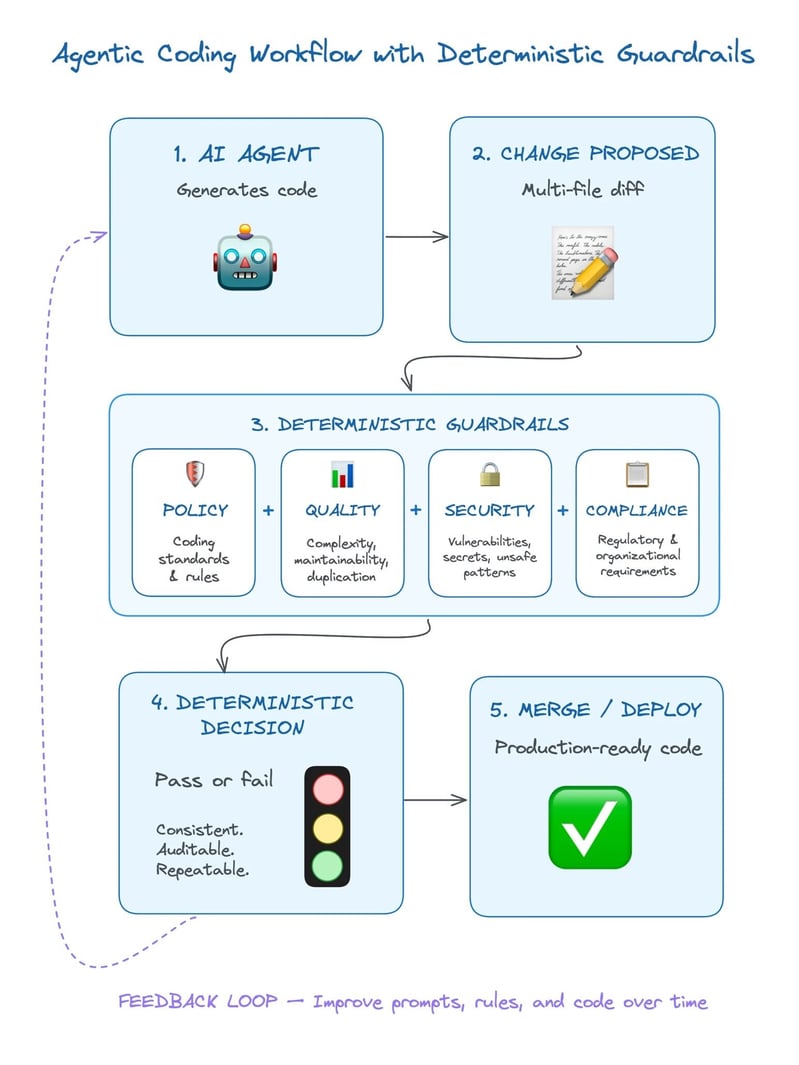
In agentic workflows with enforced CI quality gates, the combined flow can be described as follows:
- The coding agent produces a change, be it a snippet of code or a whole feature.
- The verification layer acts as the enforcement point. It evaluates the diff produced by the agent, runs deterministic checks, and returns a structured result: pass, fail, or warn, with explicit reasons tied to rules or tests. That result determines whether the change is accepted or rejected.
- If the verification fails (meaning that the system finds the aforementioned errors or vulnerabilities), the process is interrupted, and structured feedback is returned for optimized actionability.
- If the result is a failure, the agent retries with the feedback provided, producing a new diff rather than modifying code blindly.
A bounded retry loop is critical. Agents should attempt correction a limited number of times (for example, one or two iterations), with clear stop conditions. When the limit is reached, the failure is surfaced explicitly.
Why fragmented tools won’t solve the coding agents issue
While on an abstract level a deterministic stack is ideal, this setup is not directly reflected by today’s approach to tooling.
Most teams deal day to day with separate static analysis tools, security scanners, CI checks, and various reviewers, be it AI or human. And while a differentiation of tools is not inherently damaging to a software development workflow, it can be inefficient. Each tool has its own rules, thresholds, and outputs, and no enforcement layer is shared between them all.
The result is not only overhead; on a team level, the consequences might include inconsistent decisions and gaps in logic and processes that easily grow wider.
In such an environment, a good verification and controlled correction workflow cannot thrive. Deterministic enforcement only works if the rules are unified, which requires a single system or platform applying them.
Platform consolidation as a deterministic enforcement model
In order to implement successful independent verification, deterministic enforcement, and agentic feedback loops that don’t collapse on themselves at review time, any engineering team needs one place where rules live, checks run, and every change is either accepted or rejected. That system becomes the enforcement point in the workflow: the place where every change is evaluated before it is accepted.
That means one system that defines the standard, executes the checks, and produces the final acceptance decision for every change, regardless of which agent or developer produced the code.
Consolidations have shared standards across repositories, engineering teams, and agents, which supports both consistent enforcement and unified reporting.
Rather than seeing platform consolidation as a reduction of tools, this concept may be best understood when imagining a stack as a system that can enforce pre-defined standards across each component.
System-level outcomes
At a system-level, this approach has a number of advantages, too:
- Reduced error propagation: Issues are caught at the point of generation, not after multiple downstream steps
- Consistent enforcement: The same rules apply across repositories, services, and agents
- Higher trust in agent output: Improved validation automatically increases trust in agents’ output quality
- Stable development velocity: Fewer late-stage failures mean fewer rollbacks and less rework
- Clear failure boundaries: When a change fails, it does so early and with a defined reason, rather than surfacing as downstream side effects
- Reduced review load: Fewer issues reach human review, because failures are resolved before a pull request is finalized
- Improved codebase maintainability: Code that is verified consistently tends to remain more structured and easier to navigate. In agentic workflows, maintainability and readability are strongly associated with refactoring behavior, helping keep codebases easier for humans and automated systems to understand and work with.
- Scalable multi-agent coordination: With shared verification standards, multiple agents can work independently without deviating from organizational rules or architectural expectations.
- Reduced cognitive review burden: Deterministic checks eliminate redundant validation work. Human reviewers can therefore concentrate on intent and system-level decisions.
What engineering leaders need to decide about agentic workflows
At the end of the day, discussion regarding independent quality gates revolves around one central topic: ownership.
When making decisions concerning infrastructure at large and whether to incorporate an extra layer of validation in their stack, engineering leaders should ask themselves:
- Who owns validation within this workflow?
- Where is it enforced, and how successfully?
- What standards define it, and are they applied consistently?
If those answers are unclear, the system will not hold as agentic development evolves and scales.
Agentic development works as a system, and verification should, too. If validation remains fragmented across tools, models, and teams, the output risks scaling out of control. In agentic development, code generation is no longer scarce; it’s verification to become the scarce resource. The teams that scale AI successfully will depend less on code generation speed and more on their ability to evaluate change systematically.
Unify visibility across AI tools, code changes, and quality signals
AI-generated and human-written code can behave unpredictably at scale. Codacy helps reveal where enforcement breaks across your engineering system.