


Most ISO 27001 checklists are written for whoever runs the ISMS: the risk assessment, the Statement of Applicability, the internal audit. Engineering gets less of the paperwork but a lot of the legwork: chasing evidence.
The 2022 edition of Annex A has a block of controls, A.8.25 to A.8.34, on how software is specified, designed, coded, tested and changed, and auditors test them against engineering's systems.
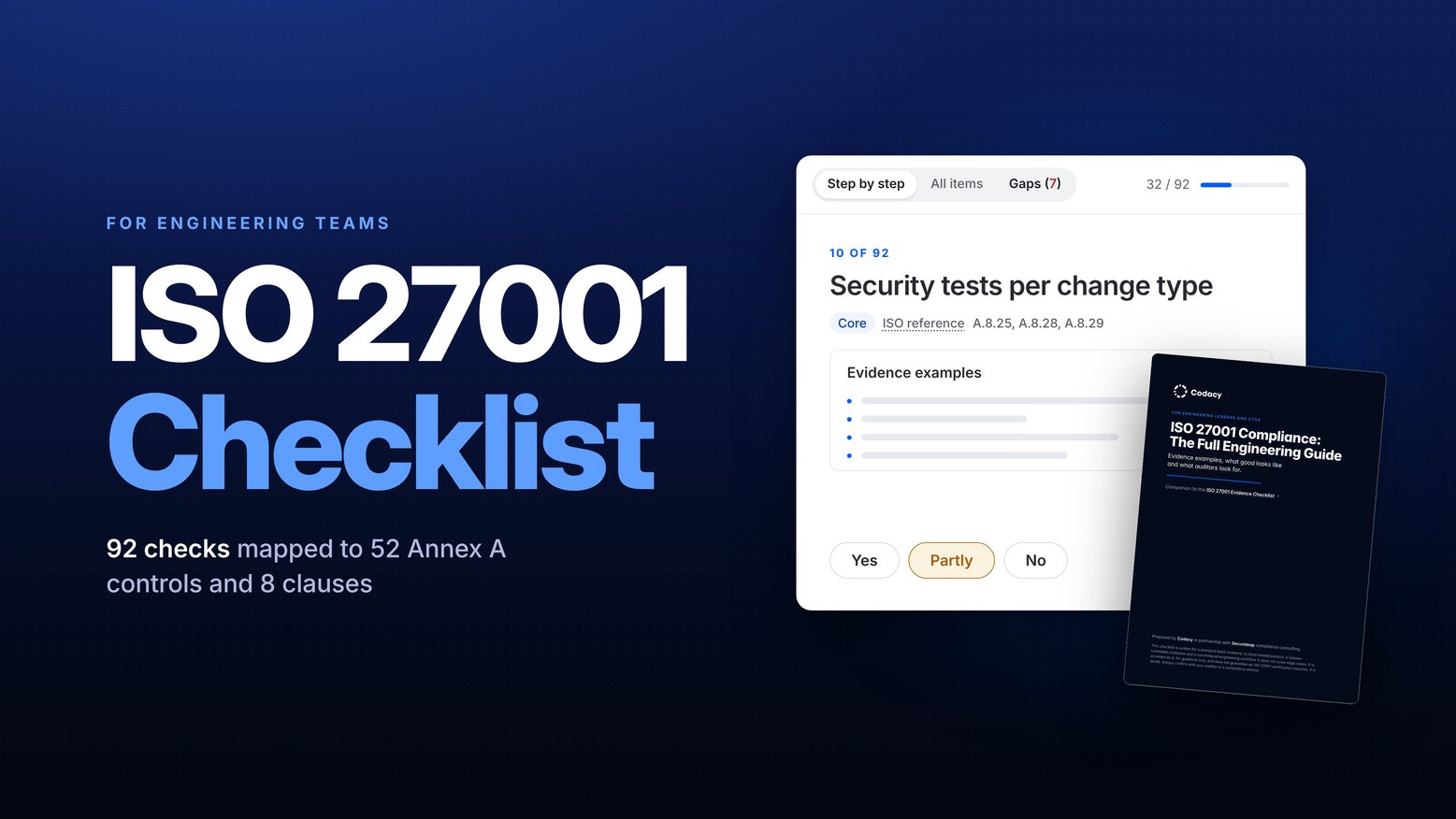
This checklist covers that part: 92 checks mapped to 52 Annex A controls and 8 clauses, each with its evidence examples, what must be in place, how auditors test it at Stage 2 and surveillance audits, and where teams usually come up short. Four of them cover the points where the ISMS needs engineering directly.
We built it because a lot of that evidence is created where Codacy works: in pull requests, where changes are checked for quality and security issues before they merge.
Start the ISO 27001 engineering evidence checklist
Secure coding standard
A written secure coding standard, approved by engineering leadership and reviewed on the cycle the policy sets (commonly once a year), defines the security rules and baseline security requirements developers follow for each language and framework in use.
In practice: do you have a written secure coding standard that covers the languages and frameworks you use, that engineers can find, and that was reviewed within your policy's review cycle?
Secure development life cycle
How your team defines and applies security rules across the whole development life cycle, not only at the end. Written rules alone don't meet it: developers have to know them and use them, so this topic covers the standard and the training that teaches it.
Who usually owns this
Usually the security engineer. In teams without one: the CTO, a senior engineer, or whoever owns security.
Evidence examples
What must be in place
How auditors test it
Reviewed at Stage 1 as documented information. At Stage 2, auditors check the approval and review dates and ask engineers how they apply the standard, often on a sampled pull request. No sample: a yearly review is checked once.
Common gap
The standard is an unreviewed template that names frameworks the team no longer uses and misses the ones it does use.
Good to know
ISO 27001 doesn't make a specific coding standard, document or scanner mandatory. What matters is that secure development rules are defined and applied in practice. The expert tier treats a written standard as Core because it is the clearest way to show this; confirm with your auditor what they expect to see.
The expert content comes from Secureleap, a compliance consultancy that prepares companies for ISO 27001 certification: the control statements, the evidence examples, how auditors sample and the gaps they see most.
This checklist is written for a standard SaaS company: a cloud-hosted product, a version-controlled codebase and a conventional engineering workflow. It does not cover edge cases. It is provided as is, for guidance only, and does not guarantee an ISO 27001 certification outcome. Only your certification body can certify you. Use the checklist to find what you can't prove yet, while there's still time before Stage 2 or your next surveillance audit. If in doubt, always confirm with your auditor or a compliance advisor.
The 92 questions come in three formats: the readiness check above, a skill for your AI assistant, and a spreadsheet bundled with the PDF guide.
Run the ISO 27001 checklist in your AI assistant with our skill
All 92 questions, one by one. It checks your connected tools for evidence first.
Download (.zip)Download the skill and your AI assistant runs the checklist with you in Claude, Claude Code or ChatGPT, wherever skills are turned on.
- The guide behind each question: the ISO reference, evidence examples, what must be in place and how auditors test it.
- Evidence before answers: before each question it checks the code host, ticketing and other tools your assistant can reach, and reports what it found. It never changes anything, and every answer is yours.
- Your gaps at the end: sorted with Core first, and how to close each one.
Nothing you answer goes to Codacy; it stays in your conversation.
ISO 27001 checklist spreadsheet and PDF guide
Tracker plus guide. A spreadsheet for your answers and a 142-page guide to every check.
Download (.zip)For a shared tracker, download the spreadsheet and PDF guide together.
- The spreadsheet has a row per check with its tier and ISO reference. Answer Yes, Partly, No or Doesn't apply (for controls your Statement of Applicability excludes), add an owner and notes, and the sheet counts your answers and gaps for you. Opens in Google Sheets, Excel and Numbers.
- The PDF guide is the reference for control owners: each check written out with its owner, evidence examples, what must be in place and how auditors test it, bookmarked by topic. It's the place to begin if your company hasn't been certified before.
Which Annex A controls does the checklist cover?
The first 12 of the 18 topics follow the 12 Annex A controls that land most directly on engineering, such as A.8.25 Secure development life cycle, A.8.28 Secure coding and A.8.32 Change management. The other 6 cover sign-in and secrets, infrastructure, logging, incidents, backups and the points of the ISMS where the auditor asks engineering directly.
Each check has a tier. 60 are Core. 11 depend on what you run: a CI/CD pipeline, containers, your own servers, contractors, a penetration test or tests against production. The other 21 are Optional improvements: a No there isn't an audit gap, but once you write an Optional practice into your procedures, the auditor will check it.
| Topic | ISO reference | What's checked |
|---|---|---|
| Secure development life cycle | A.8.25 | Secure coding standard, secure coding training |
| Secure coding | A.8.28 | Review before merge, code scanning (SAST), secret scanning, open-source license check, pinned third-party actions |
| Application security requirements | A.8.26 | Security design review |
| Secure architecture | A.8.27 | Secure architecture principles |
| Security testing in development and acceptance | A.8.29 | Security tests per change type, testing before production, required checks before merge, dynamic scanning (DAST), penetration test, production tests agreed in advance |
| Management of technical vulnerabilities | A.8.8 | Dependency scanning, container image scanning, server scanning, fix deadlines by severity, vulnerability exceptions, pentest findings tracked, security advisories reviewed, vulnerability disclosure contact, supported versions |
| Access to source code | A.8.4 | Protected branches, restricted and reviewed bypass, named and traceable accounts, list of production repositories, pipeline admin access, least privilege, periodic access reviews, approved access grants, timely access removal |
| Change management | A.8.32 | Ticket for every change, second approval on every path, emergency changes, production data fixes, complete list of changes, rollback plan, pipeline files under review, traceable build artifacts |
| Separate environments | A.8.31 | Separate production environment, secured non-production environments, deploys only through the pipeline |
| Configuration management | A.8.9 | Baseline configuration and review, hardening baselines, live configuration monitoring, drift detection, infrastructure as code through the pipeline, infrastructure code scanning |
| Outsourced development | A.8.30 | Outside developers follow your rules |
| Test information | A.8.33, A.8.11 | No production data in development or test |
| Sign-in and secrets | A.5.17, A.8.5, A.5.16 | MFA everywhere, SSO for engineering systems, just-in-time and break-glass access, secrets in a managed store, leaked secrets rotated, per-service secret access, machine credential inventory |
| Inventory, network and cloud | A.5.9, A.8.20, A.8.22, A.5.23 | Production system inventory, network segmentation and exposure, cloud shared responsibility |
| Logging and monitoring | A.8.15, A.8.16, A.8.6 | Central security logs, tamper-proof logs, alert rules with owners, alert triage recorded, capacity monitoring, alerts when monitoring stops, threat detection, sensitive data kept out of logs |
| Incident response | A.5.24, A.5.26, A.5.27, A.5.28, A.5.37 | On-call coverage, incident records, postmortems, corrective actions tracked, incident or recovery exercise, incident evidence preserved, operating runbooks |
| Backups, recovery and encryption | A.8.13, A.8.24, A.5.30, A.8.14, A.8.10 | Automated backups, off-site backup copy, restore tests, isolated and immutable backups, disaster recovery plan, security in the recovery setup, redundancy for critical systems, encryption at rest, encryption in transit, key management, data deletion |
| ISMS touchpoints | Clause 6.1.3, Clause 9.1, Clause 10.2, A.5.36 | Engineering risks in the risk register, Statement of Applicability entries, engineering security metrics, nonconformities and corrective actions |
How common are ISO 27001 audit findings?
More common than a certificate suggests. Of more than 1,700 ISO 27001-certified companies audited by DNV, 78% had at least one audit finding. A finding can be an observation or an opportunity for improvement, so it doesn't mean they failed, but 40% had at least one nonconformity, major or minor. Operations security, the area covering change management, backups, logging and vulnerabilities, had more findings than any other.
| Finding | Share of certified companies |
|---|---|
| At least one audit finding, observations included | 78% |
| At least one nonconformity, major or minor | 40% |
| A finding in operations security (change management, backups, logging, vulnerabilities) | 38% |
Source: DNV, audits of more than 1,700 ISO 27001-certified companies.
What does an ISO 27001 auditor sample from engineering?
At Stage 2 and every surveillance audit, auditors ask for the full record of a control since the last audit, such as every merged pull request, access review or restore test. They check it's complete, then pick a sample. Most of it comes straight from your systems: configuration exports, scanner output, tickets and incident logs. Here's one check in full.
|
Security tests per change type Core · A.8.25 · A.8.28 · A.8.29 · Usually owned by the engineering manager · Policy: Secure Development Policy The check. The development procedure defines the security tests each type of change needs before release (for example, automated tests of sign-in and access rules when they change, a review of security settings for infrastructure changes, and any scans the procedure requires), and the results are kept with each change. What must be in place.
Evidence examples.
How auditors test it. Auditors read the test requirements and check them on the change sample, looking for security tests on changes that touched security functions. Common gap. Functional tests run on every change, but nothing tests that access rules still hold after a permission change. Good to know. ISO 27001 requires security testing to be defined and run in the development process, not SAST or DAST as such. You set the scope and frequency of testing from your applications and risks, and penetration testing is evidenced separately when your risk decisions require it. |
How to use the checklist before your next audit
- Answer for the time since your last audit. Yes, Partly or No for each check, or Doesn't apply where your Statement of Applicability excludes the control. Step through the checks or open the full list.
- Close Core gaps first. Core checks cover the clauses and the Annex A controls almost every software company declares applicable, so expect them to be tested. Optional checks are improvements, not audit gaps.
- Give every gap an owner. Export your answers to the spreadsheet and note, for each gap, the owner, where its evidence is kept and when it was last gathered.
- Or switch to your AI assistant. The skill you download includes the answers you've already given.
- Send the PDF guide to control owners. It gives each owner the full detail behind their checks.
Where do engineering teams pick up nonconformities?
Rarely on missing policies. Usually on records that don't show a control ran:
- A Statement of Applicability that doesn't match reality. Stage 2 tests the controls it says are implemented; one engineering never put in place is a nonconformity.
- Records nobody kept. If an access review or a settings export wasn't saved when it happened, it can't be produced later.
- Manual controls with no trace. Restore tests, incident timelines and access reviews only count if someone did them and wrote it down.
- Exceptions nobody approved. An emergency fix merged without review, or a vulnerability left unpatched, is acceptable when documented and approved. Undocumented, it's a finding.
- Screenshots without a date. The auditor can't tell which day they prove.
- Admin overrides. A single admin merge without approval is enough for a finding in the change sample.
Every check asks the same thing: can you show this evidence today? Each No or Partly goes on your gap list.
Get the ISO 27001 Evidence Checklist →
ISO 27001 questions from engineering teams
What is ISO 27001, and what does it mean for engineering?
ISO/IEC 27001 is the international standard for an information security management system (ISMS): how a company manages its information security risks, chooses the controls it needs and keeps them working. An accredited certification body audits the ISMS and decides whether to certify it. Customers ask to see the certificate in security reviews and procurement.
For engineering, it means the Annex A controls on building and running software have to work and leave records: every change reviewed, access granted and revoked on schedule, vulnerabilities closed by the deadlines you set, incidents logged and backups restored in a test. Your security lead owns the ISMS, but the auditor tests these controls against engineering's systems.
Is ISO 27001 a certification?
Yes. An accredited certification body audits your ISMS and decides whether to certify you. The certificate is valid for three years: a surveillance audit follows in each of the first two years, then recertification. Only the certification body decides whether you are certified.
The audit has no score. Auditors record what they find as nonconformities, major or minor, and can add observations and opportunities for improvement. Each nonconformity needs a corrective action. A major one has to be fixed, and the fix verified, before a certificate is issued.
What are the ISO 27001 requirements for software teams?
ISO 27001 has two parts. Clauses 4 to 10 set out how you run the ISMS: scope, risk assessment, the Statement of Applicability, internal audit, management review and improvement. Annex A lists 93 controls in four themes: organizational (A.5), people (A.6), physical (A.7) and technological (A.8). Your risk assessment decides which controls apply, and your Statement of Applicability records each one, with the reason.
The Annex A controls that land on engineering most often:
- A.8.25 Secure development life cycle and A.8.28 Secure coding: your rules for building securely, and how they show up in every change.
- A.8.26 Application security requirements and A.8.27 Secure system architecture and engineering principles: security decided before the code is written.
- A.8.29 Security testing in development and acceptance: the security tests a change passes before release.
- A.8.8 Management of technical vulnerabilities: scanning, fix deadlines and exceptions.
- A.8.4 Access to source code and A.8.32 Change management: who can change code, and how a change gets from a pull request to production, emergency fixes included.
- A.8.31 Separation of development, test and production environments and A.8.9 Configuration management: environments, baselines and infrastructure as code.
- A.8.15 Logging, A.8.16 Monitoring activities and A.8.13 Information backup: logs, alerts, backups and restore tests.
Annex A says what a control must achieve, not how. Numbers such as approvals per change, days to fix a critical vulnerability or how often you review access come from your own policies, and the auditor holds you to them.
ISO 27001 Stage 1 vs Stage 2: what does each audit check?
Stage 1 of the certification audit reviews your documented information: policies, procedures and the Statement of Applicability. Stage 2 tests that the controls run, by sampling records. After certification, a surveillance audit every year samples again from the time since the last audit, and recertification follows every three years. So evidence has to be collected during the year: a setting you export today doesn't show it was on three months ago, and a skipped access review can't be done after the fact. Keep dated exports as you go.
For engineering, Stage 2 is the one that counts. Stage 1 is mostly about documents; Stage 2 and every surveillance audit sample records from the time since the last audit: for a first certification, since the control started, and since the previous audit after that.
How long does ISO 27001 certification take?
Certification bodies commonly expect around three months of records before Stage 2, so the controls have to run before the audit, not just exist. After certification, surveillance audits follow in years one and two, and recertification in year three. In between, the controls keep running on the cycle your policies set, such as quarterly access reviews and a yearly incident or recovery exercise. Put the recurring evidence (access reviews, restore tests, exercises) in the calendar before you book the audit.
How far back does ISO 27001 evidence need to go?
To the last audit. For a first certification, that means since each control started; after that, since the previous audit. Auditors sample from that whole time, so evidence from soon after the last audit must still exist. Certification bodies commonly expect around three months of records before a first Stage 2.
What happens if the auditor finds a nonconformity?
It needs a corrective action. A minor nonconformity doesn't stop certification once the certification body accepts your corrective action. A major one has to be fixed, and the fix verified, before a certificate is issued. Engineering's part is the same either way: record the failure, find the root cause, fix it with an owner and a due date, then check that the fix worked.
What is the Statement of Applicability, and what does engineering put in it?
The Statement of Applicability is the ISMS document that lists every Annex A control, whether it applies, why, and how it is implemented. Your security lead owns it. Engineering makes sure the controls it runs are described as they really run, and that every control it excludes has a reason. In our checklist, an item you answer "Doesn't apply" is one your Statement of Applicability excludes, with the reason.
Which ISO 27001 controls are new in the 2022 version?
The 2022 edition regrouped Annex A into 93 controls in four themes and added 11 new ones. Eight of them appear in our checklist: A.5.7 Threat intelligence, A.5.23 Information security for use of cloud services, A.5.30 ICT readiness for business continuity, A.8.9 Configuration management, A.8.10 Information deletion, A.8.11 Data masking, A.8.16 Monitoring activities and A.8.28 Secure coding. Certificates to the 2013 edition expired or were withdrawn by 31 October 2025, so audits now use the 2022 edition.
Does ISO 27001 require code review?
Not by name. A.8.28 Secure coding names no tool or practice, and A.8.32 Change management doesn't say how a change is approved. In practice, a review by someone other than the author before merge is how most software teams show both, and auditors sample it. Our checklist rates it Core.
Does ISO 27001 require penetration testing?
Not by name either. ISO 27001 asks for security testing to be defined and run in the development process, and for technical vulnerabilities to be found and fixed, without naming a method. In our checklist a penetration test is Optional. If your procedures require one, the auditor checks the latest report and its scope, and every finding has to be tracked to a fix or an approved exception.
Does ISO 27001 require specific tools?
No. Annex A names no products, and the tools in our checklist are examples: any code host, cloud or scanner will do, as long as the control runs and you keep its records. Figures such as "commonly 5 to 10" sampled pull requests are typical, not required; your policies set them.
Do you still need a checklist if you use Vanta or Drata?
A compliance platform helps run the ISMS: policies, tasks and some automated evidence. It can't decide what your team does with an emergency fix or a vulnerability you can't patch, and those engineering decisions are where auditors find nonconformities. Teams use the platform to run the program and the checklist to go control by control through engineering's part.
Thank you to Secureleap, the compliance consultancy that prepared the expert content in this checklist with Codacy: the control statements, what good looks like, the evidence examples, what auditors check and the common gaps. ISO 27001 doesn't prescribe tools, numbers or frequencies: where this checklist gives them, they are common choices, not requirements. ISO 27001 is a certification: an accredited certification body audits you, and only it decides whether you are certified.