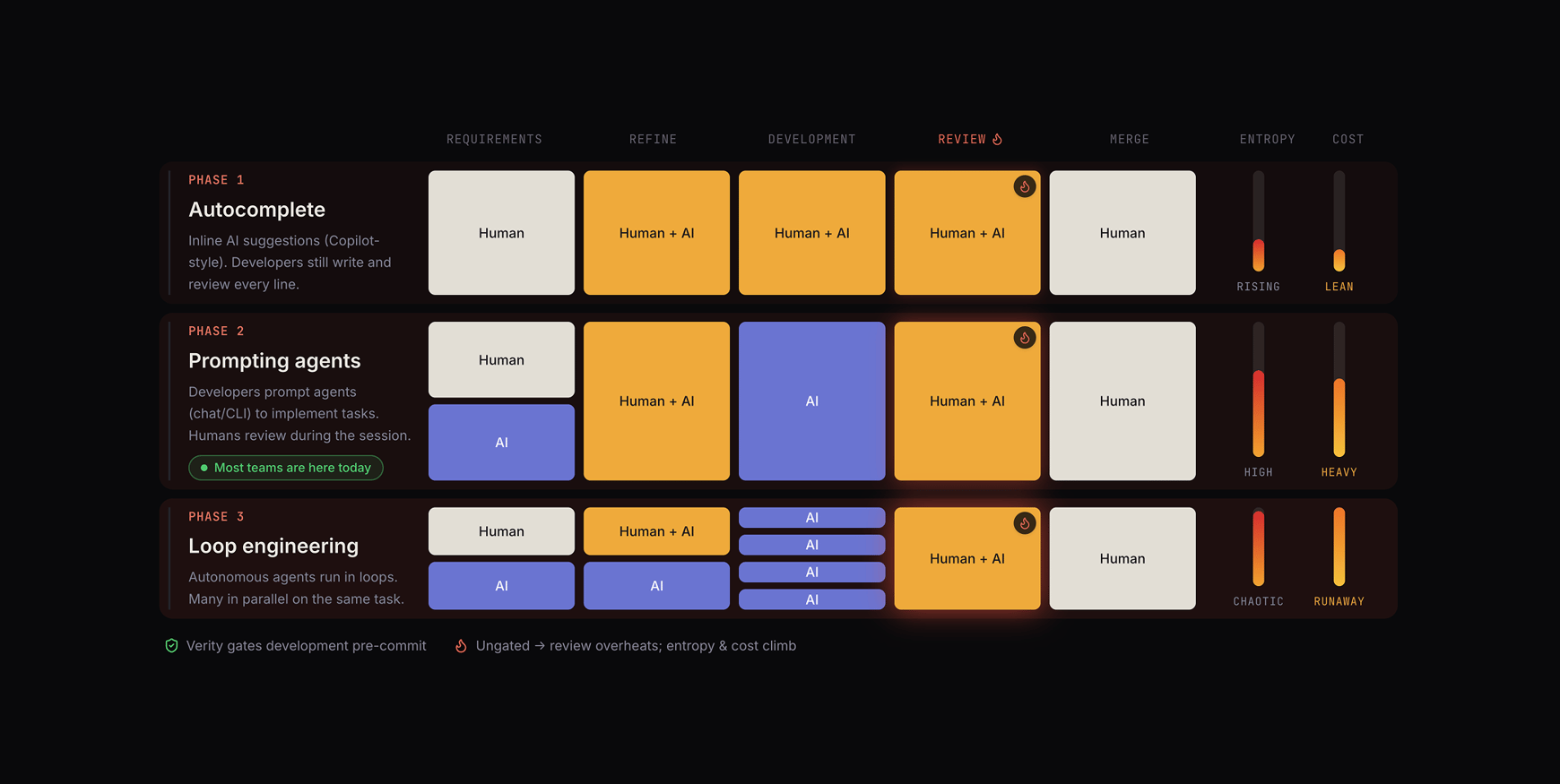
Over the last few quarters, we talked to hundreds of software teams about how they're actually using AI coding agents. What surprised me was that most teams are running autocomplete in one repo, agents building whole features in another, and already experimenting with loops against their own infrastructure. Often in parallel, sometimes in the same sprint.
It helps to map what we heard against the actual software development lifecycle (requirements, refinement, development, review, merge), because the pattern holds up across most of the teams we talked to.
AI showed up first inside the editor, autocompleting code as people wrote it. That stage is collaborative: developers refine, develop, and review alongside the model, and at this point it's pretty much a universally good idea. Nobody really argued against autocomplete.
Then came prompting coding agents, where the agent takes the lead on development and the developer's role shifts toward direction and review. This is where a lot of teams sit today: the average developer is already spending something like 20 hours a week inside Claude Code, and that shift in autonomy has pushed more of the real work downstream, onto review.
The stage after that is loop engineering: agents running on their own schedule, wired into your systems, operating with close to full autonomy and putting maximum pressure on whatever review process is left. Most teams are heading this way, and they're doing it while increasing budget per developer, not cutting it.
The most interesting part to me was that most teams are at all 3 stages at the same time. They're running autocomplete in one repo, agents building whole features in another, and already experimenting with loops against their own infrastructure. Often in parallel, sometimes in the same sprint, rather than climbing one step at a time.
What is consistent across all of them is the direction. Everyone is ready to hand agents more autonomy, hand off the recurring and mechanical work, and let people move up to the part of the job that still needs a human judgment call. Most teams are further down that road than they realize.
The most common way teams end up in loop engineering isn't a dramatic all-in bet either. It's agents watching production logs or bug reports and opening PRs automatically, usually running alongside the prompting workflows the team already has. And the volume of code coming out of agents running in loops is already forcing teams to rewrite git flows that were built for humans opening one PR at a time, not agents committing continuously.
Still, this comes with real risk. We've watched companies scale agents uncontrollably and pay for it later in entropy and runway cost, which is the kind of accumulated mess and burn that shows up months in, not on day one.
I condensed what I learned from these conversations into the video below which describes the AI coding maturity scale. Watch it and you'll probably recognize exactly where your team sits.
Verity.md is gates, memory, and cost control for coding agents. It's in beta now, free to use, and installs in about two minutes.
Stay updated with our monthly newsletter.
.svg)