.svg)
Why Engineering Teams Keep Building In-House AI Code Review Tools, and What It Really Costs

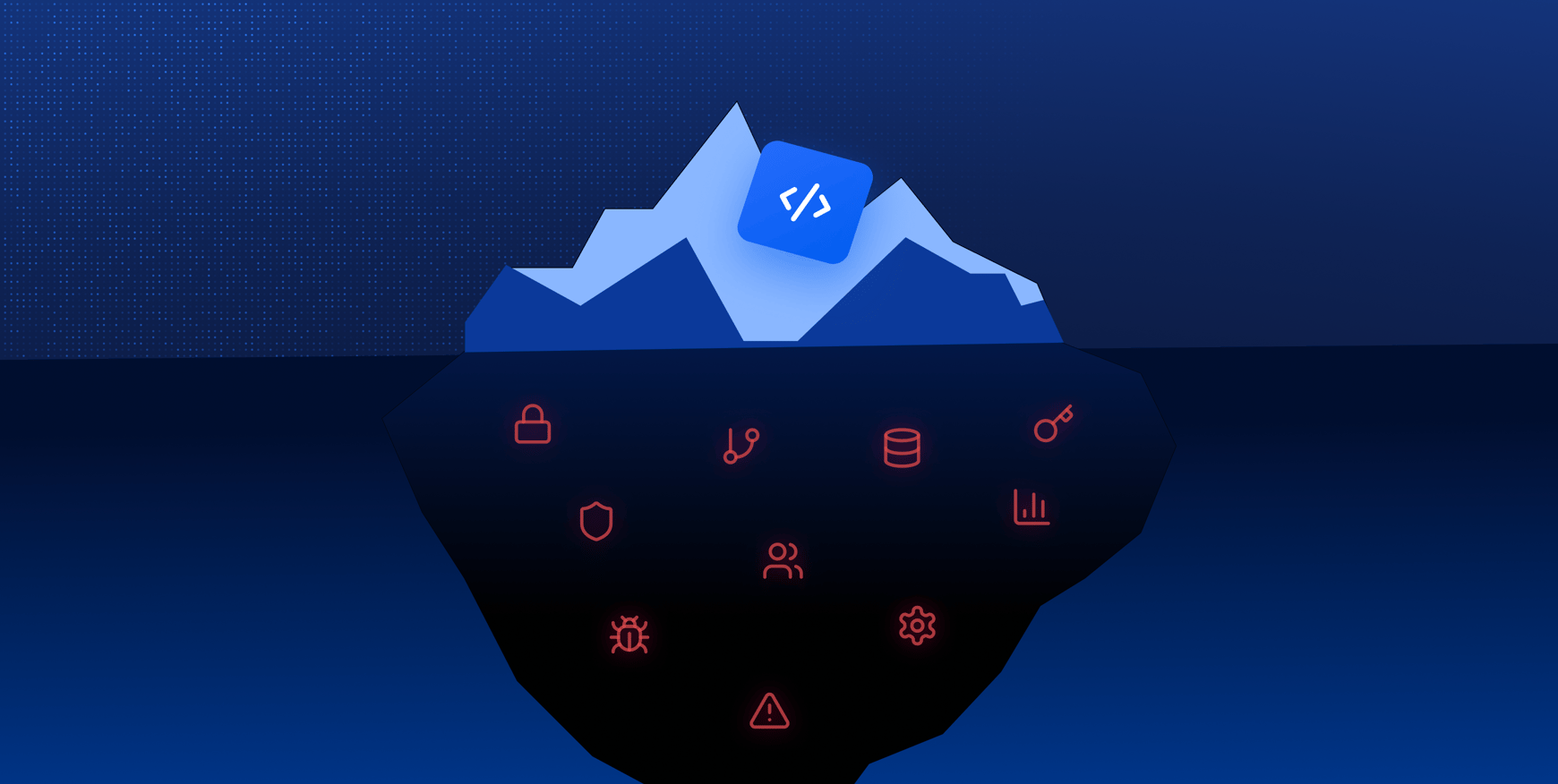
LLMs made internal AI code review tools easy to prototype. They did, however, not make them easy to operate.
That difference matters for engineering leaders deciding whether to build or buy AI code review tools. A working prototype can appear in a few days. A reliable review system, on the other hand, has to keep up with languages, vulnerabilities, policies, exceptions, developer behavior, compliance evidence, and model changes every week after launch.
For teams with limited security staff and growing AI-assisted development, the build vs buy AI code review tools decision should start with ownership. Most strong engineering teams can build something useful. Fewer should own the operating model behind it.
The AI tooling trap engineering teams are walking into
Engineering teams are quietly spending real time building internal AI PR reviewers, security analysis agents, and code quality automations. The pattern is understandable.
A VP Engineering sees review depth declining as monthly merged pull requests rise 23% year over year. Developers are using AI-assisted development tools, which increases code output and shifts more burden onto reviewers. Security findings arrive late or in separate dashboards. Compliance evidence still requires manual gathering. Then someone wires a pull request diff into an LLM and gets a useful review comment back.
That first result changes the conversation. Buying now feels slow. Building feels obvious.
The trap is that the prototype proves only one thing: an LLM can produce useful comments on a PR. However, this is not the same as having a durable system for code quality, security analysis, policy enforcement, and compliance evidence in place.
A solid and reliable in-house AI reviewer has to work inside the real delivery workflow. That means that it should be able to reach and work with repositories, branches, pull requests, merge gates, CI/CD, exception handling, ownership, and audit trails.
Once those requirements appear, the project stops being a clever automation and becomes something else: a permanent internal product. And, as any respectable permanent internal product, it’s easier said (or, rather, imagined) than done.
The false signal: “we built it in a couple of days”
The phrase “we built it in a couple of days” is often true. It is also incomplete and, at times, unreliable by itself.
A first version can take a weekend because an MVP is the easy part. A first version has easy tasks in mind, like sending code to a model and asking for feedback. The production version, on the other hand, may need to distinguish new findings from duplicates, respect accepted risk and suppressions, feed merge policies, and preserve evidence for downstream reporting.
Most importantly, it must stand the test of time.
This is where the build vs buy AI code review tools decision changes shape. The question moves from initial engineering effort to weekly ownership. Who maintains model prompts? Who updates security data? Who handles false positives? Who proves to auditors that checks ran consistently? Who explains why a risky change passed the gate?
A tool that works a handful of time is an interesting experiment. A tool that governs code at the point of change is an operating system for tried-and-true engineering policy.
4 reasons why teams actually build in-house AI code analysis tools
Most teams do not start building because they want to own a code quality and security product. The need normally arises because a specific workflow gap becomes urgent.
Compliance or security feature gaps
Sometimes a customer requirement exposes a gap fast. One organization built an internal PR security tool because it needed OWASP Top 10 coverage, CWE mapping, and threat modeling on pull requests.
That is a rational response when a deal, audit, or customer commitment is on the line. The first version often focuses tightly on the immediate requirement. The real risk comes later, when the tool is expected to remain current with new vulnerabilities, new mappings, new frameworks, and new evidence needs.
A customer-driven build can close an urgent ticket, but it can also create a permanent ownership obligation that was never budgeted in the first place.
UX and workflow gaps
Other internal tools are conceived because the existing process is painful. In one case, a product produced useful findings, but bulk triage through the UI was slow, so an engineer decided to build an interactive terminal workflow to filter, select, and mark issues faster.
The deeper issue was not necessarily missing analysis. The repeated noise may have needed organization-level configuration or permissions. The engineer did not know who had those permissions, so they built a workaround, to make it quick and actionable.
This is common. Internal tools often form around governance friction rather than product requirements and conflicts. If configuration paths, permission models, and ownership are unclear, engineers route around the system, which is a dangerous practice when the tool needs to be adapted (and quickly) for production work.
Developer adoption gaps
Teams also set out to build internal tools when manual rollout fails. An engineering team may attempt to roll coverage across a huge number (let’s say 1,200) of repositories manually. Developers merged only a small number of onboarding PRs in a month despite sustained effort (let’s say 21). To save time, the team would be tempted to build an agentic workflow to scan repositories and create onboarding or coverage PRs automatically.
That would solve one bottleneck. But it would also expose the next one. Developers would still have to merge the generated PRs.
Automation can move the process forward, but if the final step depends on voluntary developer action, adoption remains unresolved. The system still lacks enforcement at the point of change.
AI value demonstration pressure
Some teams are also under pressure to show practical AI value. This is not always a direct build-vs-buy decision. It shows how engineering organizations are creating agentic workflows around existing quality and security problems. AI is becoming the default workaround for backlog reduction, onboarding, and review scale.
The pressure from above is real. However, it should still be separated from the decision to own long-running code review infrastructure.
The real cost is the operating model
Once a prototype becomes part of the PR workflow, the costs show up in places that rarely appear in the original estimate.
Deterministic analysis vs. pure inference
A reliable code review system needs two kinds of analysis.
Deterministic analysis uses repeatable checks: static analysis rules, dataflow, dependency intelligence, known vulnerability data, secrets patterns, and policy definitions. Inference uses an LLM to reason over code and context.
Pure inference is tempting because it is fast to assemble. One internal stack that sends PRs directly to Claude without a deterministic engine underneath can produce useful findings, but it also creates predictable problems: non-deterministic outputs, higher token costs, inconsistent findings, no guaranteed access to current vulnerability intelligence, limited explainability, and weak compliance evidence.
Running deterministic rules through an LLM prompt adds inference cost to work that can often be handled by stable rules. Deterministic analysis should run separately, using current security data and stable rules. The model should receive only the relevant context.
If your internal AI reviewer does everything through prompts, you are paying inference costs for work that should be handled by deterministic systems.
The deduplication tax
Every team that builds code review tooling discovers deduplication. Dangerously, many discover it late.
Developers will tolerate a tool that finds real issues. They will not tolerate a bot that repeats the same comment across every PR. A review system has to know whether an issue is new, existing, accepted, fixed, or intentionally ignored.
That requires finding identity across commits, branch and PR awareness, suppression logic, baseline management, historical memory, and repository-level policy context. None of that comes from the LLM. It has to be engineered.
Teams may easily find that deduplication takes more time than the engine itself. That should not surprise anyone who has operated static analysis or vulnerability workflows at scale. Deduplication is a full engineering problem, and it is one reason specialized code quality and security platforms exist.
Coverage drift
Internal tools usually cover the problem that existed on the day they were built. The codebase does not stay still.
Over time, the tool has to keep up with new languages, frameworks, vulnerability disclosures, dependency advisories, CWE and OWASP mappings, secrets patterns, infrastructure as code risks, cloud configuration risks, compliance requirements, and model failure modes.
The risk is subtle because the tool keeps running. Developers still see comments. Dashboards still show activity. Leadership assumes coverage exists because the system has not failed loudly.
A stale security tool is dangerous because it creates confidence without explicitly showing current coverage.
Intent analysis is harder than outcome analysis
Most AI PR reviewers inspect the outcome of a change. They look at the diff and comment on code quality, security, or maintainability.
The deeper problem that goes at times unseen is intent. Did this PR implement the change it was supposed to implement? Did it do something unexpected relative to the issue, surrounding code, architecture, or policy?
That distinction matters more than it might seem. Secure-looking code can still implement the wrong behavior. A malicious insider can make a change that passes local checks. AI-generated code can satisfy the prompt while violating business intent or architectural constraints.
This is the next ceiling for many internal systems. Commenting on code is useful. Verifying change intent at the point of merge is much harder.
Governance problems masquerade as tooling problems
It’s easy to imagine an engineer build a terminal workflow because triage is painful. The deeper and hidden problem behind that pain, however, could easily be unclear ownership and permissions for reducing noisy findings at the organization level.
Before approving an internal build, ask whether the real problem is tooling, permissions, ownership, or process design.
If engineers cannot find the owner, they build local tools. If policy configuration is inaccessible, they create workarounds. If enforcement is unclear, each team invents its own route around the friction, which only creates more friction down the line. The bottleneck, if not addressed, always moves downstream.
Owner dependency and tool rot
A team who has already put “a lot of money” into an internal agentic review harness for AI-generated code might find a roadblock when leadership recognizes overlap with external products and has not yet evaluated the internal tool directly.
That situation is common. Internal tools often depend on one or two builders. Documentation is thin. Production support is informal. Roadmap ownership is unclear. The tool becomes a product only after it breaks and breaks something else in production in the process.
Additionally, when the original owner leaves or changes teams, the product they have built is often adrift: prompt logic ages, integrations break, model APIs change, repositories drift, and nobody knows whether findings are still trustworthy.
Every internal tool is one resignation away from becoming a black box nobody can properly take care of.
A practical build-vs-buy framework for AI code review and security analysis
The build vs buy AI code review tools question should not start with “Can we build this?” Most strong engineering teams can. Start with seven operating questions.
- Identify the exact gap. A feature gap requires different treatment from a workflow gap, adoption gap, or governance gap. If developers cannot change organization-level policy because permissions are unclear, building another UI may only hide the problem.
- Decide whether the capability is temporary or permanent. A one-time remediation workflow can be a good internal build. A continuous control that runs across every PR, every repository, and every framework is a long-term product.
- Separate deterministic analysis from inference. Current CVE data, dependency advisories, secrets detection, SAST rules, and compliance mappings should not depend on prompt behavior.
- Define deduplication before rollout. If the tool cannot manage baselines, suppressions, accepted risk, and finding identity across branches, developers will learn to ignore it.
- Choose the enforcement point. PR comments alone do not enforce policy. CI checks, merge gates, repository rules, and exception workflows are where defined standards become actual behavior.
- Assign ownership after launch. The owner must maintain prompts, integrations, policies, model behavior, security data, and reporting. If nobody owns that, the tool will rot.
- Compare against buying after 30, 60, and 90 days. The comparison should include engineering time, maintenance burden, coverage, false positives, adoption, compliance evidence, and the vendor capabilities being duplicated.
When building in-house makes sense
Building can be the right decision when the problem is narrow, time-bound, and specific to your organization.
A custom internal tool makes sense for a one-off migration, a targeted backlog cleanup, a temporary customer requirement, or an internal workflow that no vendor should reasonably support. It can also make sense when your organization has strict data residency constraints and a dedicated platform team ready to operate the system.
The key is scope discipline. Build the smallest useful automation. Avoid turning it into the default control plane for code quality and security unless you are prepared to fund it like a product.
When buying is usually the better decision
Buying is usually the better decision when the capability must run continuously across repositories, languages, teams, and compliance requirements.
That includes SAST, SCA, secrets detection, dependency risk, policy enforcement, AI code governance, and compliance evidence. These systems may need current security intelligence, stable finding identity, audit trails, integrations with Git and CI/CD, and consistent enforcement across teams.
For engineering organizations without dedicated security functions, the value is less about avoiding engineering work once. The value is avoiding permanent ownership of coverage, deduplication, policy, and reporting.
A unified platform also reduces fragmentation. Instead of running separate systems for code quality, security scanning, dependency checks, and AI code governance, teams get one policy layer and one place to collect evidence.
Conclusion
LLMs have made AI code analysis easier to prototype, but not easier to operate.
The first version of an in-house AI code review tool can be impressive and still be the wrong long-term investment. Internal tools tend to solve the problem visible on the day they were created. Code quality and security enforcement have to keep moving with the codebase, the threat landscape, compliance requirements, and developer workflows. There are products already built with all those needs in mind.
The build-vs-buy question should not be “Can we build this?” For most capable engineering teams, the answer is yes.
The better question is: “Do we want to own this system every week after it ships?”
Don’t turn AI code review into another internal product to maintain
Apply code quality, security, and AI coding standards across your engineering workflow with Codacy.