.svg)

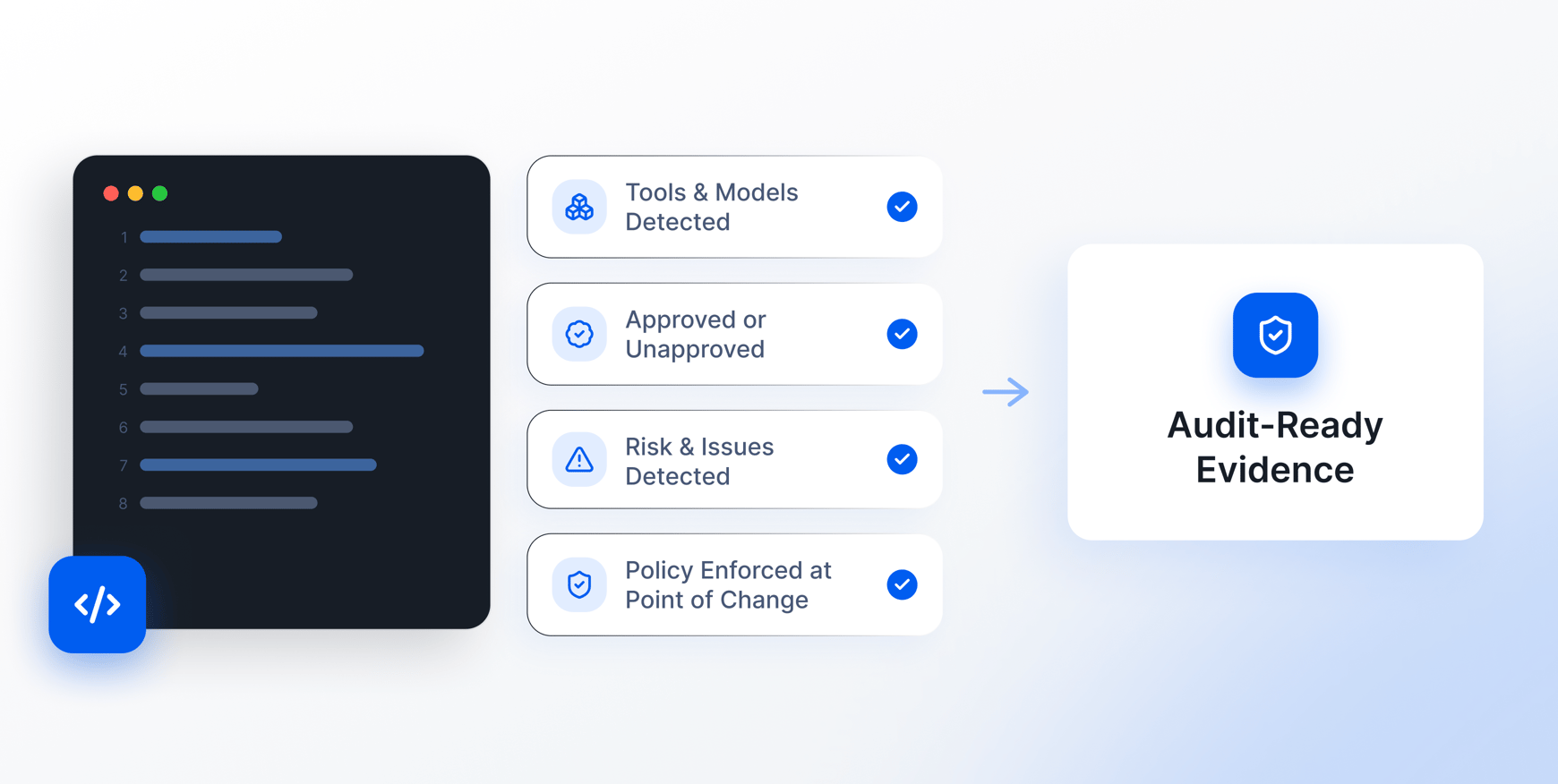
Developers are already using AI coding tools. The question auditors are starting to ask is not whether your team has an AI policy, but whether you can prove it is being followed.
AI-generated code audit evidence and emerging concepts such as the AI Bill of Materials (AIBOM) are becoming important tools for providing that proof. They provide the visibility needed to track what code is generated, where it originated, which tools and models are in use, and whether policy was enforced at the point of change. This article covers the specific questions auditors are likely to ask, the evidence engineering leaders can start collecting now, and how to build an audit trail before someone requests one.
In this article:
- Why AI-generated code creates a new compliance gap
- What auditors are likely to ask about AI-generated code
- The difference between AI governance and AI audit readiness
- What evidence engineering leaders can start collecting now
- Why manual AI compliance tracking breaks down
- How to prepare before the audit request arrives
- Common mistakes to avoid
Why AI-generated code creates a new compliance gap
AI-generated code audit evidence and the AI Bill of Materials (AIBOM) are emerging as important mechanisms for secure and compliant software development.Together, they provide the visibility and proof of provenance organizations increasingly require: tracking what code is generated, where it originated, and how AI models behave in practice. Without records like an AIBOM, engineering teams face a widening gap between what their AI policies say and what they can actually demonstrate during an audit.
AI coding assistants increase code volume while reducing the reliability of traditional review-only controls. Developers often use multiple tools across IDEs, terminals, browser-based assistants, and agentic environments. Meanwhile, the organization's AI policy sits in a document somewhere, disconnected from actual repository activity.
AI usage ends up fragmented across repositories, local developer environments, CI/CD workflows, Git history, configuration files, and tool-specific references. Leadership often cannot easily prove what is happening in practice. A written AI policy is not enough if the organization cannot produce repository-level evidence that the policy is being followed.
What auditors are likely to ask about AI-generated code
Do you have an AI policy for software development?
Organizations pursuing AI governance or compliance initiatives should expect auditors to ask for a clear policy covering how AI tools may be used in development. A typical policy defines approved AI tools and models, restricted or prohibited tools, allowed and prohibited use cases, rules for secrets and proprietary code exposure, and review requirements for AI-generated changes.
Policy alone is only the first layer, though. The follow-up questions are where things get more specific.
Can you show an inventory of AI usage across repositories?
An AI inventory identifies AI resources referenced or used across codebases. It helps answer questions like: Which repositories reference AI models? Which files contain AI resource references? Are teams using approved or unapproved AI resources? Are there mentions of specific tools, models, agents, or AI workflows?
An AI inventory becomes the foundation for demonstrating that you know where AI is being used, not just where you think it is being used.
Can you produce an AI Bill of Materials?
An AIBOM is a structured record of AI-related components, tools, models, and workflows used in software delivery. While a Software Bill of Materials (SBOM) tracks software components, an AIBOM tracks AI resources and AI-enabled development inputs.
An AIBOM typically contains:
- AI tools used by engineering teams: Which assistants, agents, or coding tools are in use
- AI models referenced or invoked: Specific model names, versions, and providers
- AI resources detected in repositories: References found in code, config files, and dependencies
- Associated repositories and files: Where each resource appears
- Approval status: Whether each resource is approved, unapproved, or under review
- Risk classification: How each resource is categorized for compliance purposes
- Evidence of review or enforcement: Records showing policy was applied
How do you detect AI-related security issues?
AI-generated code is subject to the same security and quality checks as any other code, but with additional AI-aware policy signals. Auditors may ask whether the organization detects vulnerabilities introduced in AI-generated changes, secret exposure, unsafe patterns, use of unapproved models or tools, and AI references that violate internal policy.
Detection extends beyond code itself. Codacy's Agentlinter scans AI agent configuration files, not just code, to catch issues in instruction files and agent definitions before they reach production.
How do you enforce policy consistently
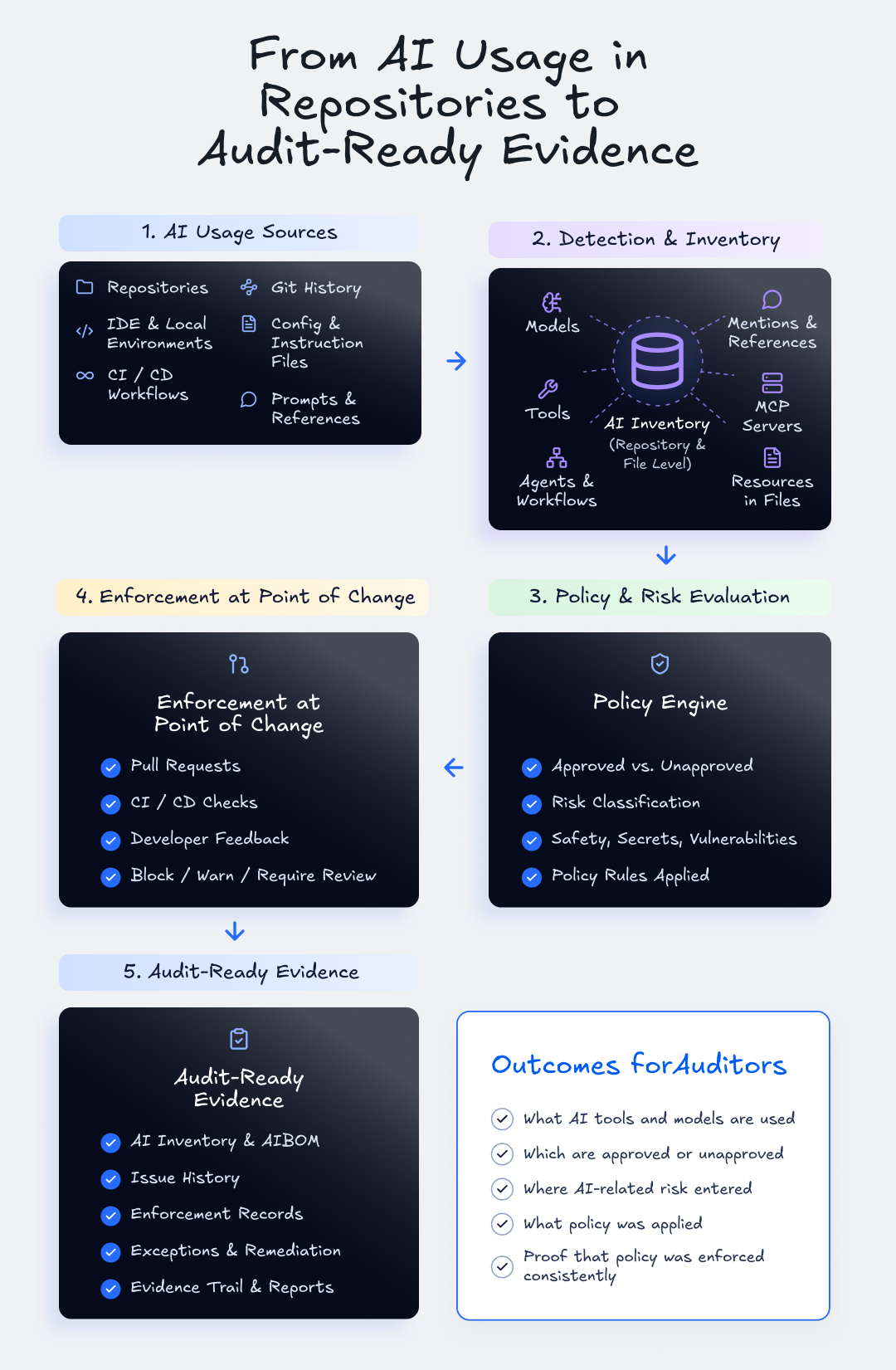
Evidence cannot depend only on manual review, spreadsheet tracking, or self-reporting. Stronger controls integrate into existing engineering workflows: pull request reviews, CI/CD checks, repository-level scanning, policy dashboards, and audit trails.
Enforcement at the point of change is what separates a policy document from a compliance system — A Gartner survey found organizations using AI governance platforms were 3.4 times more likely to achieve high effectiveness in AI governance.
The difference between AI governance and AI audit readiness
Governance defines what is supposed to happen. Audit readiness proves what did happen. The two are related but distinct.
| Governance | Audit readiness |
|---|---|
| Policy: approved rules | Evidence trail: records that can be reviewed later |
| Inventory: AI usage identified | Enforcement: violations flagged during development |
| Standards: what is allowed | Documentation: what was allowed, blocked, or flagged |
Many teams overinvest in policy documents and underinvest in evidence collection. As Ray Eitel-Porter discussed in Codacy's AI Giants series, effective AI governance requires more than written policies. It requires operational systems that produce continuous evidence.
The EU AI Act and frameworks like ISO/IEC 42001 are accelerating this shift. Compliance is moving from periodic audits to continuous evidence requirements.
What evidence engineering leaders can start collecting now
Repository-level AI inventory
List AI models, tools, resources, and references detected across repositories. Include file-level traceability where possible. Track changes over time so you can show what was present at any given point.
Approved and unapproved AI resource mapping
Maintain a policy-defined list of approved tools and models. Detect references to unapproved models or tools. Provide a way to show why something was allowed, blocked, or flagged.
AI issue history
Track AI-related findings across repositories. Categories typically include safety issues, secrets, vulnerabilities, unapproved AI models or tools, and policy violations.
Pull request and CI evidence
Show when AI-related issues were detected during review. Show whether checks passed, failed, or were overridden. Capture the link between a policy and an enforcement event.
Exceptions and remediation
Document exceptions when unapproved tools are allowed temporarily. Track remediation of risky AI-related code. Ensure exceptions are visible and time-bound.
Why manual AI compliance tracking breaks down
Spreadsheets, developer surveys, and informal approvals do not scale. The problems compound quickly.
- Developers use different tools across teams: What one team uses may differ entirely from another, and no central record captures the variation.
- AI references appear in different file types and workflows: Config files, dependency manifests, environment variables, and commit metadata all contain AI signals.
- Usage changes faster than manual inventories can track: By the time a spreadsheet is complete, it is already outdated.
- Reviewers may not know a change was AI-assisted: Without automated detection, AI-generated code looks the same as human-written code — and gaps in test coverage enforcement go unnoticed.
- Audit evidence becomes stale within weeks: One-time inventories are outdated by the time they are complete.
With 45% of AI code samples failing security tests, organizations need automated validation and reliable evidence collection to manage AI-related risk.
How to prepare before the audit request arrives
1. Define the AI development policy
Decide what is approved, restricted, and prohibited. Include models, tools, data handling, review requirements, and exception handling.
2. Create an AI inventory baseline
Scan repositories for AI resources and references. Identify unknown or unapproved usage. Establish a baseline before auditors ask for one.
3. Map policy to enforcement
Convert policy language into detectable rules where possible. Decide what blocks, warns, or requires review. Align enforcement with pull requests and CI/CD.
4. Build the AIBOM
Use inventory data to produce a structured view of AI resources and workflows. Connect resources to repositories, files, approval status, and issue history.
5. Preserve evidence continuously
Keep records of detections, reviews, exceptions, and remediation. Avoid one-time audit scrambles.
Common mistakes to avoid
- Treating AI compliance as a policy document instead of an enforcement system: A policy without enforcement is a statement of intent, not a control.
- Relying on developers to self-report every AI tool they use: Self-reporting misses tools developers do not think to mention or do not realize they are using.
- Ignoring file-level and repository-level traceability: Auditors want to see where AI is used, not just that it is used somewhere.
- Tracking approved tools but not unapproved usage: Knowing what is approved is only half the picture.
- Checking AI-generated code only after merge: By then, the code is already in the codebase.
- Separating AI governance from existing SAST, secrets, SCA, and code quality workflows: AI governance is not a separate discipline. It is an extension of existing code quality and security practices.
-
Waiting for regulations or auditors before creating an evidence trail: The time to build evidence is before someone asks for it.
Practical takeaway for engineering leaders
The near-term goal is not to perfectly identify every line written by AI. That level of precision is not yet practical, and auditors are not expecting it.
The goal is to prove that the organization has a defined AI development policy, a live inventory of AI resources and tools, a way to detect unapproved or risky AI usage, consistent enforcement in engineering workflows, and evidence that can be shown during audit review.
AI audit readiness is an operational discipline, not a one-time compliance exercise. The organizations that build an evidence trail now will be better positioned when auditors, regulators, or customers start asking the questions that are already on the horizon.
Build your AI audit evidence trail before auditors ask for it
Codacy AI Risk Hub and AI Inventory help engineering teams detect AI resources, monitor AI policy compliance, and produce the evidence needed for AI-generated code audits.