.svg)

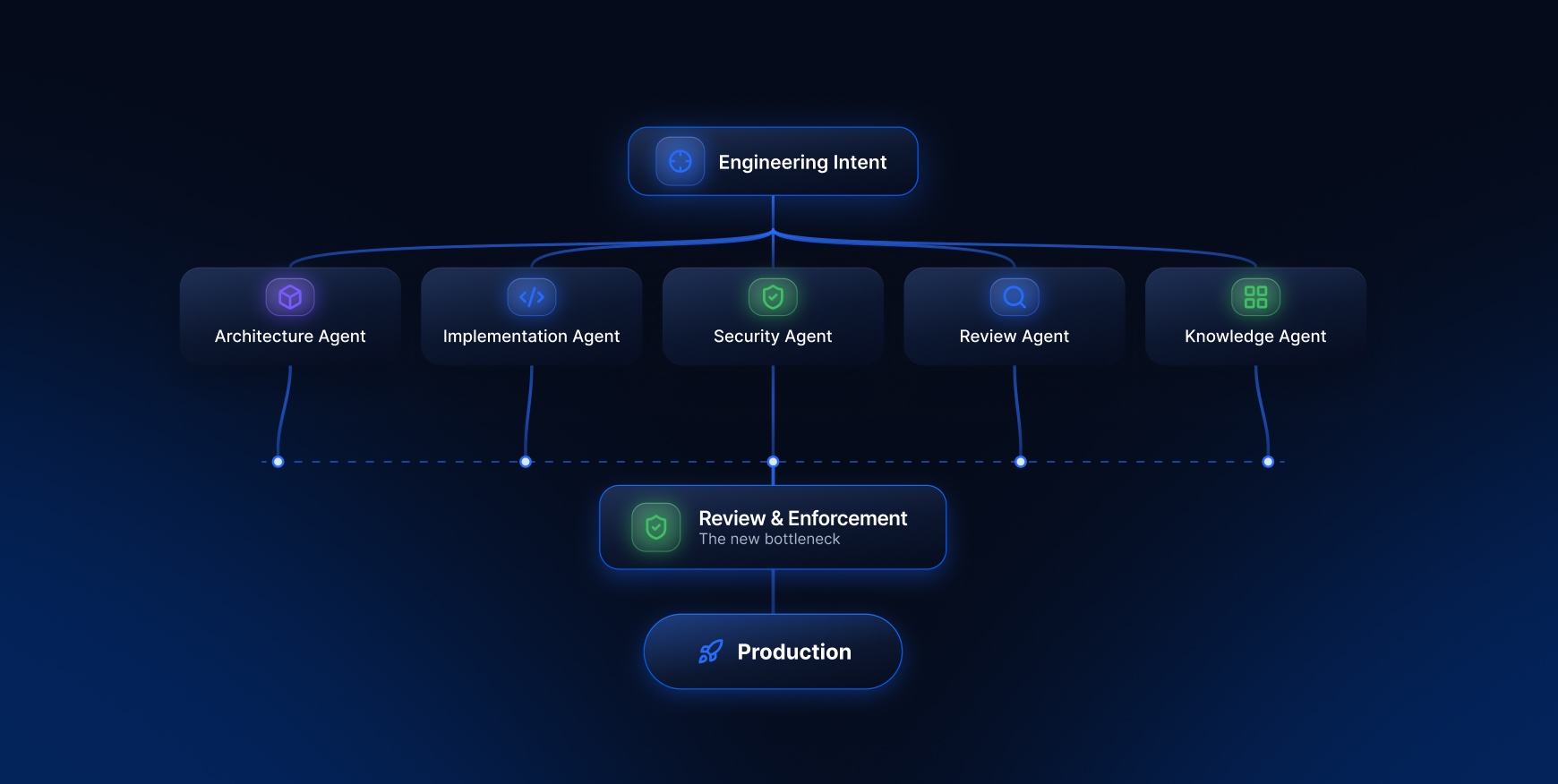
A growing number of senior engineers describe a similar pattern: writing only a small amount of code manually while AI agents generate much of the rest. Imagine a senior engineer's day-to-day: they may write maybe twenty lines of code manually while AI agents generate the rest. Their job has shifted from typing implementation to defining intent, decomposing problems, and reviewing output. The code still ships, and the architecture still holds. But the work looks nothing like it did even only a year and a half ago.
This shift from code production to agent orchestration is reshaping how engineering teams operate, where bottlenecks form, and what controls actually matter. The following sections cover how agentic workflows function in practice, why review becomes the central constraint, and what engineering leaders can do to maintain quality and security as AI-generated code volume increases.
In this article:
- What changes when AI agents handle implementation
- The agentic workflow loop
- Compound engineering and accumulated context
- Why senior engineers become more architectural
- The review burden as the central constraint
- How security changes shape in agentic development
- Tooling fragmentation and consistent enforcement
- Standardization as the missing layer
- Practical operating principles for engineering leaders
What changes when AI agents handle implementation
AI agents are transforming software engineering from manual coding into agentic workflows. Rather than offering autocomplete suggestions, agents now act autonomously: taking a high-level goal, building a plan, researching context, implementing changes, testing their work, and iterating without constant human intervention.
The developer's role shifts from builder to orchestrator.
Think about the progression most engineers experience. Early AI assistance meant autocomplete and small snippets with high error rates requiring close manual inspection. Current AI agents understand broader goals, generate implementation plans, and interact with external tools. Interest in these workflows is growing rapidly, with Gartner reporting a 1,445% surge in multi-agent system inquiries.
This shift requires learning new practices. Agent quality and tooling change quickly, so teams benefit from adaptable workflows rather than rigid vendor-specific assumptions.
The agentic workflow loop
The agentic workflow operates as a loop rather than a single prompt-and-response exchange. Each cycle moves through distinct phases that build on each other.
- Brainstorming: AI explores the problem space and possible approaches before any code is written.
- Architecture and planning: The chosen direction converts into a code-driven implementation plan with clear constraints.
- Execution: Agents modify code, create branches, push commits, or open pull requests based on the plan.
- Review: Both AI review agents and human reviewers inspect correctness, simplicity, security, and maintainability.
- Retrospective and knowledge capture: Lessons, decisions, and context are preserved for future sessions.
The important pattern here is role separation. Agents work best when they are not treated as one generic assistant. Implementation agents, review agents, security agents, and retrospective agents each operate with different instructions and permissions. This specialization mirrors how human engineering teams divide responsibilities.
Compound engineering and accumulated context
AI-assisted development is able build reusable knowledge, prompts, skills, and session artifacts with the aim of improving future work. Some practitioners describe this approach as compound engineering.
Each session produces both code and context that informs future sessions. Architecture decisions, repository-specific conventions, security expectations, known failure modes, review criteria, and preferred implementation patterns all accumulate.
When agents are guided by accumulated, codebase-specific knowledge, they become dramatically more useful. However, if this knowledge is inconsistent, stale, or ungoverned, agents compound bad assumptions just as easily as good ones. The quality of the knowledge layer directly shapes the quality of the output.
Why senior engineers become more architectural
The role shift for senior engineers is significant. They spend less time typing code and more time on system design, task decomposition, coordination across parallel workstreams, and review decisions. AI makes it possible to tackle more system-level problems at once, including work that was previously delayed due to bandwidth constraints.
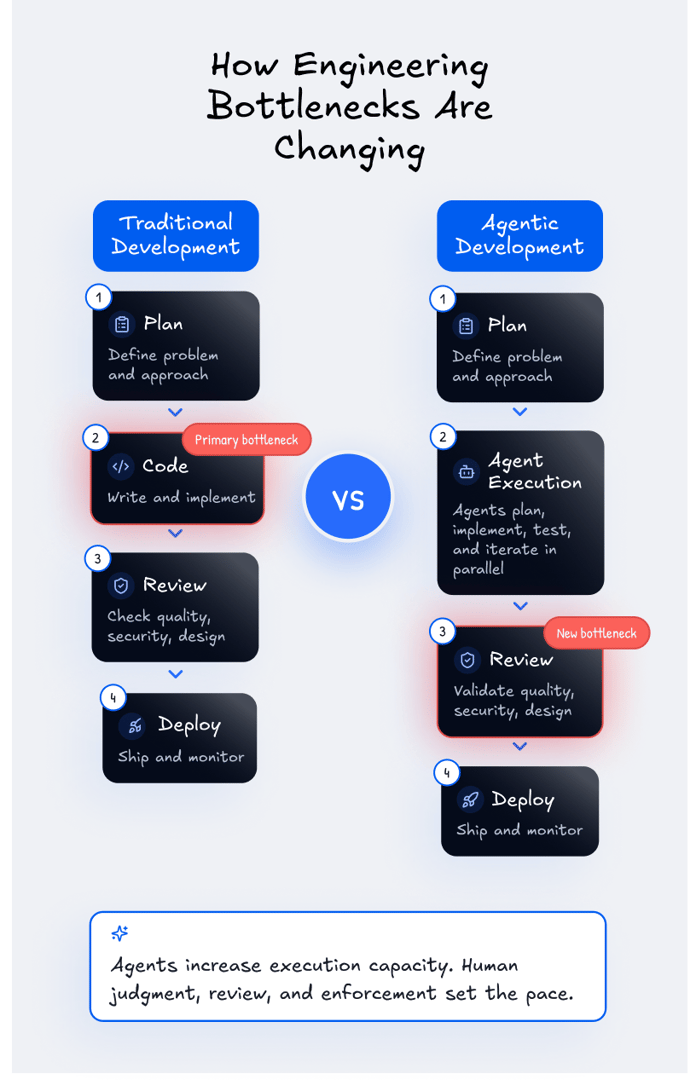
Yet speed creates a new bottleneck: review capacity. Instead of a smaller number of developers, teams may end up needing more engineers capable of handling the increased throughput and decision load.
The work becomes more cognitively demanding, even when developers are excited by the speed and quality gains. Orchestrating multiple agent workstreams while maintaining architectural coherence requires sustained attention that differs from traditional implementation work.
The review burden as the central constraint
When agents produce more code, review becomes more important. Human review cannot simply scale linearly with AI-generated output.
The risks are concrete:
- Review fatigue: Reviewers face higher volumes with the same time constraints, and 38% find AI code harder to review than human-written code.
- Reduced inspection depth: Surface-level checks replace thorough analysis.
- Over-trusting generated code: Familiarity with agent output breeds complacency.
- Architectural drift: Small inconsistencies accumulate across repositories without detection.
- Sticky code: AI-generated code tends to persist in codebases for long periods, making initial review quality even more critical.
AI review agents can catch issues earlier, though they do not replace human accountability. A practical standard emerging in some teams: no production code ships without being seen by at least two developers. Yet "seen" is not enough unless review is supported by consistent automated enforcement.
How security changes shape in agentic development
Agentic development changes security in two directions. Agents can introduce risk through generated code, tool access, and unintended actions. At the same time, agents can help investigate logs, summarize incidents, inspect code paths, and suggest fixes quickly.
Security concerns worth tracking include:
- IP and source code exposure: Code sent to AI providers may be retained or processed according to provider policies.
- Privacy and data handling: Sensitive data in prompts or context windows creates compliance risk.
- Model training opt-outs: Contractual protections vary by provider and plan.
- Agent access to production systems: Over-permissioned automation expands attack surface.
- Generated insecure patterns: Agents may produce code with vulnerabilities they cannot detect.
- Dependency and supply chain changes: Agents introduce dependencies at speed without human review of provenance.
Agents are not infallible security tools. They are part of a layered workflow. A common security model keeps humans accountable for decisions while using AI-assisted early detection, automated SAST, SCA, secrets scanning, and policy checks at pull request and CI/CD boundaries.
Tooling fragmentation and consistent enforcement
Teams use different models, agent frameworks, IDEs, and vendor suites. Some companies are locked into large vendor ecosystems. Others choose a varied set of tools based on model quality and task fit.
Because model quality, pricing, and capabilities change quickly, engineering teams can expect tool churn. The real operational need is a stable enforcement layer that remains consistent regardless of which agent generated the code.
This is where unified code quality and security platforms fit. They evaluate code changes consistently across repositories, surface quality and security issues in pull requests, and support SAST, SCA, secrets detection, and code quality checks. The goal is standardizing enforcement when development workflows become more fragmented.
| Challenge | Fragmented approach | Unified enforcement |
|---|---|---|
| Policy consistency | Varies by tool and repository | Single policy engine across all code |
| Review overhead | Multiple dashboards and alert streams | Consolidated findings at PR level |
| Audit evidence | Scattered across tools | Exportable compliance reports |
| AI-generated code governance | Fragmented or incomplete visibility into AI-specific risks | AI policy checks and tools like AI Inventory |
Standardization as the missing layer
The ecosystem has not yet converged on a standard set of practices for how teams use agents safely and effectively. Teams benefit from internal practices covering:
- Which agents are allowed for which tasks
- What data can be shared with models
- How agent-generated code is labeled or reviewed
- What permissions agents have in Git, CI/CD, and production tools
- When human approval is required
- How prompts, skills, and context files are maintained
Treating agent workflows as engineering systems, not personal productivity hacks, creates consistency. Standardization covers both creation and enforcement. Creation includes prompting, planning, session orchestration, and knowledge capture. Enforcement includes PR checks, security policies, dependency controls, required reviews, and audit trails.
Practical operating principles for engineering leaders
For engineering teams navigating the transition to agentic coding, several principles help navigate this transition.
- Measure review quality rather than lines generated. Track escaped defects, cycle time, and policy adherence rather than raw AI output volume.
- Separate agent roles. Use different instructions and permissions for implementation, review, security, and retrospective work.
- Keep humans accountable. Agents can recommend and execute, but humans own production decisions.
- Capture reusable context. Convert lessons into repository-specific guidance rather one-off chat history.
- Limit permissions. Agents operate with the minimum access needed for their role.
- Enforce at pull request and CI/CD boundaries. Prompt discipline alone is not sufficient.
- Expect tool churn. Build workflows that survive model and vendor changes.
- Protect reviewer attention. Use automated checks to remove repetitive review burden so humans can focus on design and risk.
The teams that benefit most from AI-assisted development will be the ones that build reliable systems for orchestration, review, security, and enforcement. Agentic development turns engineers into orchestrators, but orchestration without guardrails creates risk.
As AI expands the volume and velocity of change, consistent automated code quality and security enforcement becomes foundational to keeping engineering teams fast without losing control.
Build guardrails for agentic development before review becomes the bottleneck
Codacy brings automated quality, security, coverage, and policy enforcement into pull requests and CI/CD, helping teams manage rising volumes of AI-generated code without sacrificing engineering standards.