.svg)

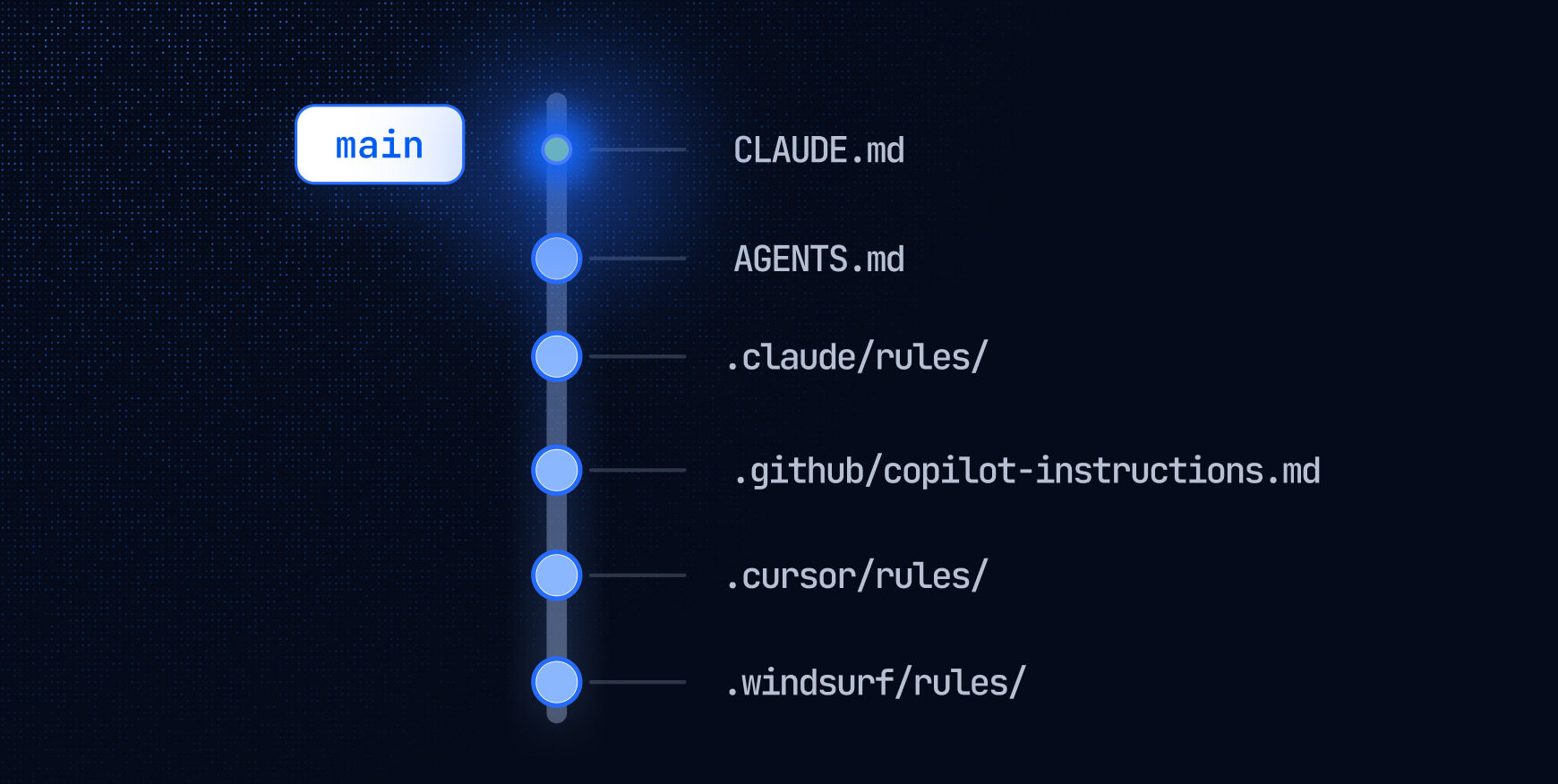
Your team already treats CI config, dependency manifests, and policy files as things that need an owner, a review, and a drift check, because they shape the code you ship. Repository instruction files like CLAUDE.md, AGENTS.md, and .cursorrules now do the same job: coding agents read them to decide how to generate, modify, and review code. But most of them currently sit outside all of it and are edited like notes, owned by no one and reviewed by nobody.
That’s been allowed to happen because a stale instruction file doesn't break a build. It just keeps nudging an agent toward the wrong architecture layer, or a retired security pattern, across dozens of pull requests before anyone traces it back to the file.
Once a file shapes the code your team ships, it deserves the same discipline as the rest of your delivery system. Here's how to bring it under that discipline.
A Familiar Pattern in a New Form
Engineering teams have seen this pattern before. A new class of file starts as a convenience, then becomes part of the delivery system.
CI configuration started as build automation. Over time, it became release policy. The YAML file did more than run tests. It decided what could merge, what could deploy, and what evidence existed when something failed.
Infrastructure-as-code started as provisioning scripts. It became production architecture. A small change in a Terraform module could affect networking, identity, availability, or cost.
Dependency manifests started as package lists. They became supply chain risk surfaces. A version pin, transitive dependency, or lockfile update could introduce vulnerabilities, license exposure, or operational instability.
Repository-level AI instruction files are the next version of that pattern. They may not execute like code, and they do not deterministically control an assistant’s behavior. But they can shape how an assistant interprets the repository, which patterns it follows, which commands it runs, and what kind of code it proposes.
That is enough to change the standard of care.
If a file influences how work gets generated, it should not live outside the engineering process that governs code, configuration, and policy. It needs owners, review, freshness checks, and a clear place in the workflow.
What Are Repository Instruction Files?
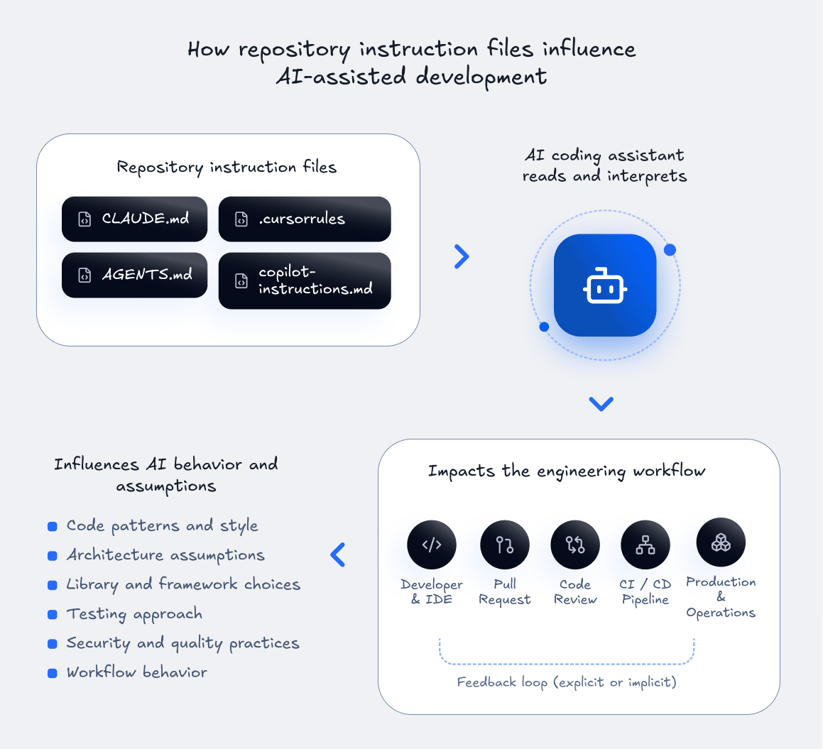
Repository instruction files are text or rule files stored in, or associated with, a source code repository. Depending on the tool and feature, AI coding assistants use them as persistent repository context when generating responses, editing code, reviewing changes, or working with the codebase.
The exact filenames depend on the tool and configuration. Current and legacy AI-assisted development workflows commonly involve files such as CLAUDE.md, AGENTS.md, .github/copilot-instructions.md, .cursorrules, or scoped rule files under directories such as .cursor/rules/. Some tools also support path-specific instruction files, where rules apply only to certain languages, folders, or file patterns.
The names differ, but the pattern is consistent: the repository can now contain instructions that influence AI-assisted development.
These files often describe the repository’s architecture, preferred libraries, testing expectations, coding conventions, build commands, security constraints, and workflow rules. A typical instruction file might tell an assistant which framework version the project uses, where API handlers live, how database migrations should be written, which test command validates a change, or which patterns are deprecated.
They can affect several parts of AI-assisted work:
- Code patterns: The assistant may prefer certain abstractions, folder structures, or implementation styles based on the instruction file.
- Library choices: The file may steer the assistant toward approved packages or away from deprecated dependencies.
- Testing behavior: Instructions may tell the assistant to add tests, run specific commands, or avoid brittle test patterns.
- Security expectations: The file may describe input validation, authentication, authorization, logging, or secrets handling rules.
- Architecture boundaries: Instructions may tell the assistant which modules can call each other, where business logic belongs, or which legacy areas require care.
This influence is probabilistic. AI assistants may interpret instructions inconsistently, ignore some guidance, or resolve conflicts in unexpected ways— Anthropic's documentation confirms Claude may pick arbitrarily when rules contradict. That uncertainty makes governance more important, not less.
A useful operator test is simple. If a junior engineer repeatedly followed a repo note when changing code, would your team care whether that note was accurate? Most teams would. They would want that note reviewed, current, and aligned with the way the system actually works.
The same standard should apply when an AI assistant reads the file.
Why Does Configuration Drift Matter for AI Instructions?
Configuration drift is a useful mental model for repository instruction files. The term already has a specific meaning in infrastructure and operations, so it should not be treated as an established industry label for AI instruction files. Still, the behavior is familiar enough to help teams reason clearly.
Configurations define expected system behavior. They evolve over time. They get copied between environments, repositories, or teams. They diverge from current standards. The divergence often stays invisible until something behaves unexpectedly.
Repository instructions can drift in similar ways.
An instruction file may say the service uses one testing framework even after the team migrated to another. A rule copied from a different repository may reference services, paths, or deployment assumptions that do not apply. A security note may reflect an old platform standard. Multiple instruction files may accumulate overlapping or conflicting guidance.
The visible file still looks harmless. The hidden issue is that outdated guidance can keep getting reinforced at the point where work is generated.
This matters because AI-assisted development changes the scale of repetition. DORA’s 2025 research found that AI adoption can improve throughput, often at the cost of software delivery stability when the underlying engineering foundation is week. A stale instruction no longer affects only the person who reads it once. It can influence many prompts, many edits, and many pull requests before anyone notices the pattern.
Early internal analysis from AgentLinter — scanning over 34,000 repositories — points to the same kind of hygiene problems engineering teams already recognize from other repo artifacts. Common findings include duplicate instructions, outdated references, missing version or update metadata, references to files that no longer exist, hardcoded secrets, and patterns that could enable data exfiltration. None of those findings mean every instruction file is risky. They do show that instruction files can develop the same operational decay as CI config, docs, policy files, and scripts.
The practical risk is quiet: unmanaged instructions become another source of hidden operational drift.
How Does Instruction Drift Show Up in Engineering Workflows?
Instruction drift usually appears as small friction, not a dramatic failure. That is why it is easy to miss.
A team migrates from one test runner to another, but the instruction file still tells the assistant to write tests using the old framework. Reviewers start seeing plausible tests that do not match the current harness. Someone fixes the first few by hand. Then the pattern repeats.
A copied rule tells the assistant to follow conventions from another service. The generated code compiles, but it places logic in the wrong layer or assumes a dependency that the service does not use. The mistake looks like a normal implementation choice until several pull requests repeat it.
Security guidance can drift as platform standards change. A repository instruction might describe an old token handling approach, an outdated logging rule, or a validation pattern that has since been replaced. The assistant may continue to suggest code that looks consistent with the repo note while falling short of current standards.
Conflicts create another class of failure. One instruction file may tell the assistant to use a particular dependency. Another may discourage it. One file may require tests for all changes, while another says to skip tests for small edits. One rule may encourage suppressing warnings to keep CI green.
Those contradictions matter because many instruction files tell agents what to do, but not what to do when instructions conflict. AgentLinter data has surfaced this as an “escape hatch missing” pattern: the instruction file gives rules without a resolution path. In a real engineering team, a developer can ask a lead or escalate in review. An assistant needs explicit guidance, such as “when instructions conflict, follow the repository policy file first” or “stop and ask for clarification before changing security-sensitive code.”
AI-assisted development increases the impact of these small defects for three reasons:
- AI can increase code volume. More code can move through the same review path.
-
In-depth human code review depth may decrease
when generated changes look reasonable. Reviewers are still responsible, but plausible code reduces the instinct to inspect every assumption. - Repeated assistant behavior can normalize outdated guidance. Once the same pattern appears in several pull requests, teams may start treating it as the current convention.
Small instruction defects can scale across many changes when they sit where work begins.
Where Is the Governance Gap?
Most engineering teams already have standards. They have expectations for testing, security, architecture, dependency use, error handling, logging, and code quality.
The hard part is enforcement.
Defined standards often live in one place while work happens somewhere else. A security policy may sit in a wiki. Architecture rules may live in a design document. Style guidance may be split between linters, PR comments, and team memory. CI enforces some rules. IDE extensions enforce others. Pull request review catches whatever the reviewer has time and context to catch.
AI instruction files often land in the gap between defined standards and enforced behavior.
They may be edited like documentation, not configuration. They may not require review from the people who own architecture, security, or platform standards. They may not have clear owners. They may not be covered by any policy check. In some repositories, developers add them experimentally because they want better assistant output, then the files quietly become part of the workflow.
That creates an awkward situation. A file can influence how code is produced while sitting outside the same controls applied to code, CI, or dependency manifests.
This is where AI code governance becomes operational rather than theoretical. Governance does not mean creating a large approval process for every prompt. It means making sure the artifacts that shape AI-assisted development are visible, reviewed, and checked where engineering work already happens.
If repository instruction files influence how code is produced, they should not be exempt from maintenance expectations.
What Should Engineering Teams Review?
The first step in managing AI coding assistant repository instruction files is to review them through the same lens used for other behavior-shaping artifacts. A useful review covers ownership, scope, consistency, freshness, safety, and maintainability.
This does not require a heavy process. It requires making the implicit questions explicit.
- Ownership: Every instruction file should have a responsible team or role. If nobody owns it, nobody will update it after architecture, testing, or policy changes.
- Scope: The instruction should clearly apply to the repository, language, framework, or path it claims to cover. Broad instructions copied across services often create misleading guidance.
- Consistency: Instructions should align with current security, testing, architecture, and code quality standards. If the instruction file says something different from CI policy, the team needs to resolve the mismatch.
- Conflict handling: Instructions should define what happens when guidance conflicts. In many cases, the assistant should stop, ask for clarification, or follow a stated priority order.
- Freshness: The file should not reference deprecated tools, retired services, old frameworks, missing paths, or former workflows.
- Safety: Instructions should not encourage insecure patterns, bypasses, weak validation, disabled checks, warning suppression, or secrets exposure.
- Maintainability: The file should be specific enough to help the assistant make better choices, but not so broad that it becomes noise.
Instruction files should also change through the same path as other important repo artifacts. A pull request should show the diff. The relevant engineering team should review it. Architecture or policy migrations should include updates to instruction files. Periodic repository checks should flag files that have not been reviewed in a long time.
The right standard is practical: if changing the file could influence generated code, the change should be visible in review.
Where Should Enforcement Happen?
Governance only works when it appears in the workflow. A policy document nobody checks becomes optional under deadline pressure. The same will happen with AI instruction hygiene.
There are several enforcement points, and each catches a different class of issue.
The IDE or editor is where AI assistance is often used. If teams can prevent bad patterns at the moment instruction files are created or edited, they reduce downstream cleanup. This applies to human-authored instruction files and agent-generated instruction files. Teams may also ask an assistant to generate repository guidance. That can be useful, but teams should avoid bad patterns from the moment those files are generated.
Local checks and Git hooks can catch simple issues before a commit. They are useful for file existence, naming, metadata, known unsafe phrases, references to missing files, or accidental secrets. They should not become the only control, because local checks are often bypassed or inconsistently installed.
Pull requests are the natural place to make instruction changes visible. A reviewer should be able to see when a repository-level instruction file changes, just as they would notice a CI workflow change or dependency manifest update. Teams can add review requirements for files that influence AI behavior.
CI/CD is where repository-wide consistency can be validated. CI can check whether instruction files follow expected structure, avoid unsafe guidance, include ownership metadata, and do not contradict known organizational rules. This is also where teams can generate compliance evidence that instruction governance is being applied consistently.
Periodic repository audits are important for organizations with many repositories. Teams of 50 to 150 developers often have enough repos to create fragmentation, but not enough security or platform bandwidth to manually inspect every file. An audit can identify which repositories use which instruction formats, where files have gone stale, and where copied rules have diverged.
Fragmented code security toolchains make this harder. Different teams may use different AI coding assistants. Different tools use different filenames and rule formats. Some teams may have repo-wide instructions while others use path-specific rules. Governance needs to reason about the pattern, not only one vendor-specific file.
The enforcement model should follow the artifact’s impact. If the instruction file shapes generated code, it belongs in the same workflow where engineering teams enforce quality, security, and change control.
Why Should Instruction Files Be Analyzable Artifacts?
The next step is to treat repository instructions as analyzable artifacts.
That does not mean every instruction file needs a complicated schema. It means teams should be able to inspect them systematically. If AI instructions increasingly shape how code is written, engineering teams need a way to understand whether those instructions are current, consistent, and safe.
Analyzing instruction files helps teams answer questions that manual review alone rarely covers across many repositories:
- Are there duplicate or conflicting instructions across the organization?
- Do instruction files reference tools, paths, or services that no longer exist?
- Do any instructions encourage bypassing tests, suppressing warnings, or weakening validation?
- Do files include hardcoded secrets or sensitive internal details that should not be there?
- Do instructions define what an assistant should do when guidance conflicts?
- Which repositories contain AI behavior-shaping artifacts outside normal review paths?
AgentLinter is one example of this category shift. The useful shift is moving from informal notes to governed inputs in the software delivery system.
Once instruction files are analyzable, teams can reason about them like other repo artifacts. They can detect stale or conflicting guidance. They can identify risky instructions that undermine secure development practices. They can surface inconsistencies across repositories. They can see where AI behavior is being shaped outside normal governance.
That AI coding visibility matters most for engineering teams without a dedicated security function. In those environments, the practical goal is to make invisible behavior-shaping files visible enough to manage.
How Should Teams Get Started?
The starting point should be small. Rather than large AI governance rollout to manage repository instruction files, most engineering teams need inventory, ownership, review, and a path to automation.
A practical starting sequence looks like this:
- Inventory repositories that contain AI instruction files. Search for common filenames and rule directories across your organization. Include repo-level, path-specific, and local variants that may have been committed by accident.
- Identify which AI coding tools and formats are in use. The goal is to understand the pattern across teams, not to force every repository into the same format immediately.
- Assign ownership for each instruction file. The owning team should understand the repository’s architecture, testing workflow, and security expectations.
- Require pull request review for instruction changes. Treat these changes like CI config, dependency manifests, or policy files.
- Compare instructions against current engineering standards. Check whether the file reflects your actual test commands, approved dependencies, architectural boundaries, and security rules.
- Remove copied or obsolete rules. A shorter, accurate file is more useful than a long file full of stale context.
- Add automated checks where possible. Start with simple checks for secrets, missing references, outdated metadata, unsafe bypass language, and missing conflict-resolution guidance.
The key is to make these files visible and owned before trying to enforce every possible rule. Once teams understand which files exist and how they are used, enforcement can expand naturally through pull requests, CI, and periodic audits.
A useful working rule is to update instruction files during the same migrations that change the system. If a team changes test frameworks, updates architecture boundaries, retires a service, replaces a dependency, or changes security policy, the instruction files should be part of the migration checklist.
That habit can prevent a significant source of drift.
The Artifact Has Changed, the Engineering Lesson Has Not
Engineering teams have learned this lesson before with CI configuration, infrastructure code, dependency manifests, and policy files. Files that begin as helpers often become part of the delivery system.
Repository instruction files are still early. Tool behavior varies. File formats differ. Assistants may apply instructions inconsistently. The ecosystem will keep changing.
The direction is clear enough to act pragmatically.
If 84% of developers are now using or planning to use AI tools in their development process, the instructions that guide them should be visible, reviewed, and maintained. They should have owners. They should move through pull requests. They should be checked for drift, conflicts, unsafe guidance, and stale references.
Once a file shapes engineering behavior, it deserves engineering discipline.