.svg)

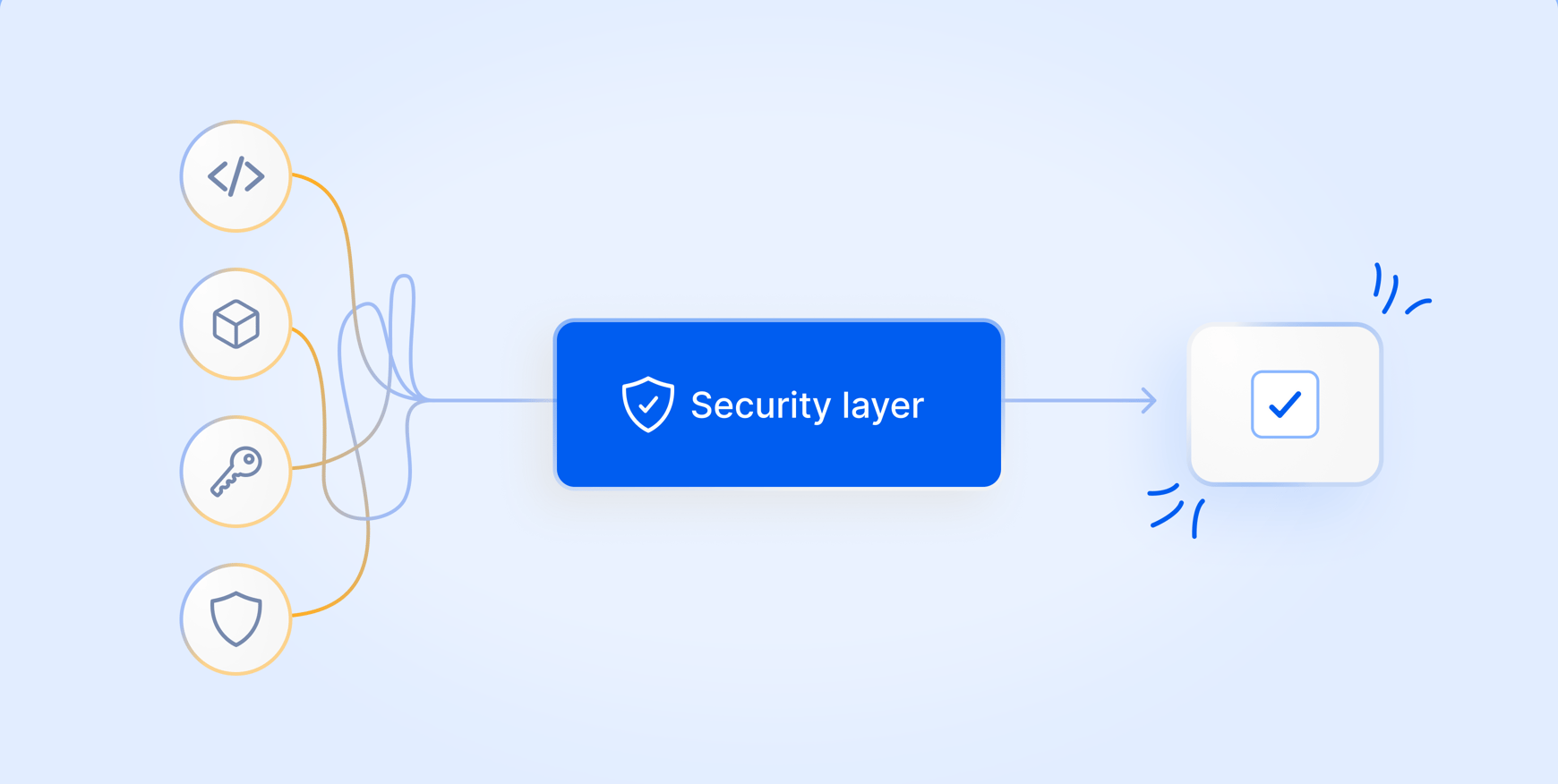
Many engineering teams don’t have the capacity to run a full security program. This is because sometimes there is no full-time security team, no time to manage multiple tools, and no bandwidth to triage hundreds of alerts across repositories.
This naturally pushes security earlier in the development lifecycle, closer to where code is written and reviewed: a shift-left model that is especially important for teams that lack dedicated security functions. With limited security resources, the emphasis should shift from tool adoption to enforcement priority. In other words, the question is no longer “What tools should we add?”, but “What must be enforced to keep our systems safe?”
This problem is becoming more visible as AI-assisted development increases software throughput. More code is generated and reviewed under tighter time constraints, while the same engineering systems are expected to maintain consistent security outcomes across all repositories and workflows.
If a team can implement only one security layer, it should shift security left and ensure enforcement occurs at the point of change, while covering as many high-priority risk areas as possible, including code vulnerabilities, dependency risks, secret exposure, and other policy violations.
Why security becomes fragmented across tools and workflows
A fragmented approach to security may look like several tools at work. One tool may block pull requests on high-severity findings, whereas another only displays issues as warnings. Static analysis may run in one platform, dependency scanning in another, secrets detection in a separate service, and container or runtime security checks in entirely different dashboards.
Branch protection rules in some repositories may require mandatory reviews and legacy workflows. Dependency vulnerabilities may be tracked in a separate security dashboard not directly connected to PR checks.
These inconsistencies become more visible as AI-assisted development reduces the amount of detailed review applied to each change and augments the volume of code. Naturally, engineers are still expected to uphold the same security standards across a growing number of changes and repositories.
All of this inevitably creates a gap between defined rules and their consistent enforcement within repositories and workflows. Without a single shared decision layer, engineers end up operating on fragmented signals. A finding’s resolution depends on where it is surfaced and how it is configured, rather than solely on a consistent evaluation of severity at the point of change. Detection exists in multiple systems, but enforcement is not applied through a single consistent decision point.
What a single security layer means in practice
A single security layer is a centralized enforcement mechanism that evaluates each code change against a predefined set of security and quality rules before it is merged or deployed. It is not a single scanner or dashboard, but rather a consistent enforcement system.
An effective security enforcement layer should work as a self-reliant operational model, and it should primarily introduce structure into how decisions regarding security are made. Ideally, it includes:
- A unified evaluation point: Every change is evaluated at the same stage (typically pre-merge), so enforcement doesn’t depend on which repository the code lives in or how it was produced. This removes team variability and guarantees that no change evades controls entirely or takes a weaker route.
- A set of deterministic rules where possible: Security rules and policy checks are encoded into automated analysis (e.g., static analysis, dependency checks, secrets detection), so outcomes are not open to interpretation. Instead of relying on reviewer judgment, the system imposes clear conditions: the same violation results in the same outcome every time.
- Context-aware support: When strict rules are insufficient, an additional AI layer can provide context, assist with intent interpretation and risk prioritization, and explain why something is important. This layer supports developers and reviewers, but does not replace enforcement. Decisions still rely on defined policies, not subjective interpretation.
- Pass/Fail/Warn decision output: All signals converge into a single decision at the enforcement point. Regardless of how many checks run in parallel, the system produces a unified outcome with consistent logic. This eliminates ambiguity at merge time and ensures that enforcement is predictable and non-negotiable.
Together, these elements work to transform security from a set of tools to an operational model in which enforcement is predictable, repeatable, and unaffected by individual workflows.
A single security layer turns rules into enforceable decisions at the point where changes are accepted or rejected. With it, security becomes enforceable; without it, it remains advisory.
This kind of enforcement layer is implemented by platforms like Codacy, which apply these checks consistently at pull request level across repositories.
See where security enforcement breaks across your codebase
From insecure code patterns to vulnerable dependencies and exposed secrets, Codacy evaluates every change against consistent security rules before it reaches production.
What security checks require consistent enforcement
A single security layer does not mean fewer checks. Instead, it means giving priority to those that are most significant.
Common application vulnerability patterns
Many of the most common and well-known risks at the application level have remained stable over the years, and are well documented in the OWASP Top 10 categories:
- SQL injection patterns
- cross-site scripting (XSS)
- authentication/authorization bypass patterns
- unsafe deserialization
- insecure input validation and handling
These are typically addressed through deterministic rule-based systems: static application security testing (SAST), linters, and pattern-based detection (for example, CWE mappings).
The common denominator is predictability: the same pattern should always trigger the same outcome.
Dependency and supply chain risk
As most modern applications rely heavily on third-party code, dependency integrity has become a high-profile security concern in most organizations, covering issues like:
- known vulnerabilities in dependencies (CVEs)
- outdated libraries with known risk exposure
- vulnerable transitive dependencies
Trust at the installation stage is becoming an increasingly significant aspect of supply chain security. In other words, a share of issues comes from how dependencies enter the system in the first place. Attackers have been known to exploit public registries by publishing malicious packages. These appear legitimate and are later consumed through regular dependency updates, which means that the risk is introduced at the point of dependency resolution.
Supply chain attacks are also extending into developer machines. Once again, this means further exposure in the presence of inconsistent trust boundaries. Repository-managed configurations like .npmrc can also be used to enforce controlled registry access and dependency policies.
In a single security layer, these signals are evaluated together at the same enforcement point when a dependency or resolution path is first introduced. With assessment happening at the point of change rather than via a separate audit, supply chain risk is addressed more directly.
Secrets and sensitive data exposure
A common cause of incidents in engineering environments is accidental exposure of secrets in source code or configs. Secrets are sensitive credentials or cryptographic materials that grant access to protected data and systems, for example:
- API keys
- service tokens
- database credentials
- passwords
- encryption keys
Leaked secrets can be used by malicious actors to gain access to your systems and data, which can in turn lead to data breaches. Attackers may also delete or modify critical information.
Secrets are commonly exposed when committed unintentionally to repositories, becoming hardcoded within the source code. Exposure time is critical, and, once credentials are pushed, rotation and potential incident response are immediately required to curb break-ins.
Therefore, secret detection is most appropriate when applied at pre-commit or pre-merge stage, with hardcoded credentials being spotted before they can be propagated. When integrated directly into the workflow, these controls reduce both the likelihood and the duration of exposure.
In modern agentic workflows, this can be expanded further into the development environment itself, where Codacy’s AI Guardrails applies pre-defined policy enforcement and automated remediation directly across agents and IDEs as the code is being generated.
Policy enforcement and coding standards
Certain security failures may emerge when organization-specific engineering standards and requirements are enforced unevenly.
These requirements are frequently linked to internal platform and application architecture decisions, which translate into enforcement points within the system (for example, authentication may be enforced at the gateway or middleware level, or database access may be governed through centralized access controls or database-level permissions).
The main point is not only to define these standards (they frequently exist in documentation or internal platform guidance), but to put them into practice. Without a centralized enforcement point, the outcome of a change is determined by where it falls in the pipeline, which repository it passes through, and how it is evaluated. This naturally may create a variation in how identical issues are handled: for example, some may be blocked in one repository while appearing as warnings in another.
Change-level risk detection
Security issues are not only introduced as large isolated changes; risk can just as easily be introduced incrementally through small modifications.
Evaluating changes at the diff level (at the point of change) makes it easier, for example, to spot insecure logic introduced in updates or new code, or regressions in previously enforced security behavior.
In a single enforcement layer model, these diff-level signals are evaluated together at commit or merge time.
Core security checks for AI-generated code
In agentic workflows, instead of individual developers writing and reviewing changes end-to-end, AI agents generate larger volumes of code per iteration, and changes are introduced with less deliberate inspection at creation time. The boundary between draft and production-ready code becomes thinner, too, and the overall increase in throughput also inherently removes natural friction where issues were previously caught.
Agentic workflows also introduce new classes of risk tied to execution context and how automated systems interact with tools and permissions. These may arise when agents are given broad repository or cloud permissions that let them make changes or trigger actions beyond what a human developer would typically execute directly, or when dependencies and tool integrations are introduced through automated workflows without the same review scrutiny applied to manual changes.
Consequently, in addition to application code, security controls must now take into account how development environments are configured, how agents interact with tools and permissions, and how AI-enabled functionality behaves within production systems. Security checks for AI-assisted workflows can be split into four core layers:
- Code-level security (SAST): They focus on insecure code patterns introduced in application logic (injection vulnerabilities, broken authentication and authorization, insecure data handling, etc.). These checks are normally handled via static analysis and rule-based detection.
- Supply chain and development environment security: It typically includes securing your local coding environment against malicious or over-privileged agent behavior and malware. Registry restrictions, lockfile enforcement, and tooling configuration (such as .npmrc policies) all have a direct impact on what external code is allowed to enter a codebase. It also encompasses risks introduced by the dev environment itself, like compromised/malicious packages or configuration-level exposure of credentials
- Agentic and AI system security: This focuses on risks created by AI systems in both development process and production runtime. The first category concerns risks within the SDLC itself. Automated systems may rely on MCP servers and other external tool integrations. If these components are misconfigured or compromised, or if malicious tooling is introduced into the development environment, agents can be made to behave incorrectly or execute unintended actions. The second category concerns risks introduced by using LLM APIs within the application (prompt injection attacks, denial-of-service or rate-based attacks that cause overspending, contract risks).
- Runtime and deployment security signals: This includes Dynamic Application Security Testing (DAST), which identifies vulnerabilities that only appear when an application is running and exposed to external traffic, and container image and deployment artifact security, which focuses on issues discovered during packaging and deployment, particularly in container images and their bundled dependencies
In agentic environments, the number of security checks becomes less of a differentiator. What separates stable systems from riskier ones is whether every change is evaluated, whether the same rules apply across repositories, and whether enforcement is automatic or discretionary. Additionally, as the change volume increases, any inconsistency compounds automatically.
How security enforcement works in the development workflow
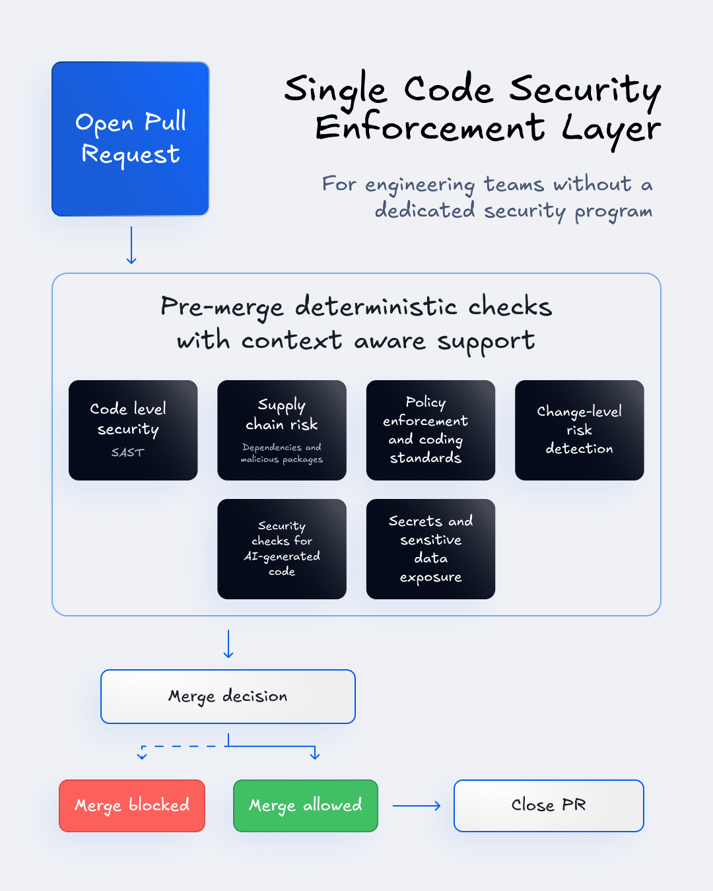
In most modern engineering setups, security is commonly enforced at the pull request stage, where multiple checks converge into a single decision point: whether a change can merge.
When a developer submits a pull request, a predefined set of automated checks is initiated. These run concurrently as part of the pre-merge validation process to evaluate the change against security and quality requirements.
At this point, various types of analysis are used to assess the change:
- Static analysis scans the diff for insecure code patterns.
- Dependency scanning checks if new or updated packages introduce known vulnerabilities (CVEs).
- Secret detection identifies exposed credentials, tokens, or configuration data
- Test suites validate functional correctness and avoid regressions.
None of these checks independently determines the outcome, but it’s the combined result to determine whether the pull request satisfies the repository’s enforcement policies.
For example, a pull request introducing an unsafe database query may pass functional tests but still be flagged by static analysis due to an injection risk pattern. Similarly, a dependency update that introduces a known vulnerability may be blocked, even if the change is otherwise low-risk.
In a unified enforcement model, these checks are applied uniformly across all repositories and workflows. Codacy operationalizes this by enforcing static analysis, dependency scanning, and secret detection at the pull request level, while also applying AI-specific policies through systems like its AI Risk Hub. This ensures that all changes, whether created by humans or AI, are evaluated against the same security rules before being merged.
Security as a consistently enforced system
Security is often discussed as a set of controls: scale, rules, and reviews applied at different points of the pipeline. But in practice, those controls matter solely if they have been consistent across every change in the system.
A security program fails not because of a lack of checks, but because those checks do not behave like a single operational model that is consistently enforced. Thresholds vary between tools, and review strictness often depends on the repository or the individual reviewer. Some checks are blocking in one workflow and advisory in another. This eventually is bound to create a system where security is present yet not reliably enforced.
Consistent enforcement reduces reliance on individual discretion or tool selection in security. It becomes a structural safeguard for the development process itself.
A secure system is not one that runs many checks, but one where every change is evaluated the same way, every time.
Apply consistent security checks to every code change
Ensure every pull request is evaluated against the same policies, so risky code never slips through due to inconsistent enforcement.