.svg)

Every engineering team knows technical debt exists. Far fewer can tell you exactly where it lives, how much it costs, or whether it is growing.
That gap between awareness and visibility is where technical debt tracking comes in. This guide covers what to track, how to measure it, which tools help, and how to build a practice that actually sticks.
In this article:
- What is technical debt tracking
- Why technical debt tracking matters for engineering leaders
- Types of technical debt to track
- How to measure technical debt
- How to track technical debt across a codebase
- How to prioritize technical debt
- What to look for in a technical debt tracking tool
- How AI-assisted development changes technical debt
- Connecting technical debt tracking to compliance and reporting
- Building a technical debt tracking practice that sticks
- Frequently asked questions about technical debt tracking
What is technical debt tracking
Technical debt tracking is the practice of identifying, categorizing, and prioritizing code compromises, outdated dependencies, and architectural shortcuts in your codebase. Think of it like treating shortcuts as loans: you took them to move faster, but now you owe future work to pay them back. Tracking makes that loan visible, measurable, and systematically payable.
The difference between knowing about debt and tracking it matters more than most teams realize. Knowing means someone on the team remembers a shortcut was taken. Tracking means that shortcut is documented somewhere, assigned a severity, and visible to everyone who makes prioritization decisions.
Without tracking, debt becomes invisible. It compounds quietly until it surfaces as slower feature delivery, harder onboarding, or a security incident that catches everyone off guard.
Why technical debt tracking matters for engineering leaders
Engineering leaders balance competing pressures: shipping features, maintaining quality, managing security risk, and keeping teams productive. Untracked technical debt quietly undermines all four.
The consequences tend to show up gradually, then all at once. A codebase that was fast to work in two years ago now takes twice as long for simple changes. New engineers take months to become productive because the architecture has drifted from any documentation that exists.
Here are the leadership concerns that technical debt tracking directly addresses:
- Velocity erosion: Untracked debt silently slows every sprint as developers work around accumulated complexity.
- Risk blind spots: Hidden complexity becomes a security and reliability liability that only surfaces during incidents.
- Resource misallocation: Without data, teams cannot make a credible case for dedicated remediation time.
- Compliance gaps: Auditors increasingly ask for evidence of code quality practices, and "we know about it" is not documentation.
Types of technical debt to track
Technical debt comes in multiple forms. Tracking only one type leaves gaps. A team that monitors code complexity but ignores dependency vulnerabilities has an incomplete picture of their risk exposure.
Code debt
Code debt is the most visible form: duplicated code, code smells, overly complex functions, and inconsistent patterns. Static analysis tools catch most of it, which makes code debt the easiest category to track systematically.
Architectural debt
Misaligned system structure creates friction that compounds over time. Monoliths that have outgrown their design, tight coupling between services, and data flows that no longer match business requirements all fall into architectural debt.
Design debt
Inconsistent APIs, unclear abstractions, and patterns that made sense three years ago but no longer fit current requirements create design debt. Design debt often shows up as confusion during code review or onboarding.
Test and coverage debt
Missing or flaky tests erode confidence in deployments. When teams stop trusting their test suite, they slow down releases or skip testing entirely, both of which create downstream problems.
Documentation debt
Outdated or missing documentation increases tribal knowledge risk. When the engineer who understands a system leaves, the team inherits a black box.
Dependency and security debt
Outdated libraries, known vulnerabilities, and unpatched CVEs represent security risk that compounds over time. Dependency and security debt often gets tracked separately from code quality, which creates visibility gaps.
AI-generated code debt
AI coding tools can introduce debt at scale if their output is not governed. Patterns like unapproved model calls, unsafe code patterns, and missing tests appear more frequently when code generation outpaces review capacity.
See where technical debt is accumulating before it impacts delivery
Codacy combines insights into code quality, security, coverage, and AI governance to assist engineering leaders in managing technical debt and reducing risk across all repositories.
How to measure technical debt
Measurement helps turn subjective concerns into measurable signals. Without metrics, conversations about technical debt become opinion battles. With metrics, teams can prioritize based on evidence.
Technical debt ratio
The technical debt ratio compares estimated remediation cost to total development cost. A ratio that trends upward over time signals that debt is accumulating faster than the team is paying it down.
Code complexity and code smells
Cyclomatic complexity measures how many independent paths exist through a piece of code. Duplication percentage and static analysis findings round out the picture. Complexity metrics are straightforward to automate and track over time.
Test coverage gaps
Coverage percentage tells you how much code lacks unit tests. Diff coverage, which measures coverage on new code specifically, serves as a leading indicator. A team with high overall coverage but low diff coverage is accumulating test debt with every merge.
Remediation time and cost
Estimating hours or cost to fix known issues helps prioritize. A high-severity issue that takes an hour to fix is a different conversation than one that requires a two-week refactor.
Defect density and change failure rate
Bugs per lines of code and deployment failure rate are lagging indicators of accumulated debt. By the time defect density and change failure rate spike, the underlying debt has already compounded.
How to track technical debt across a codebase
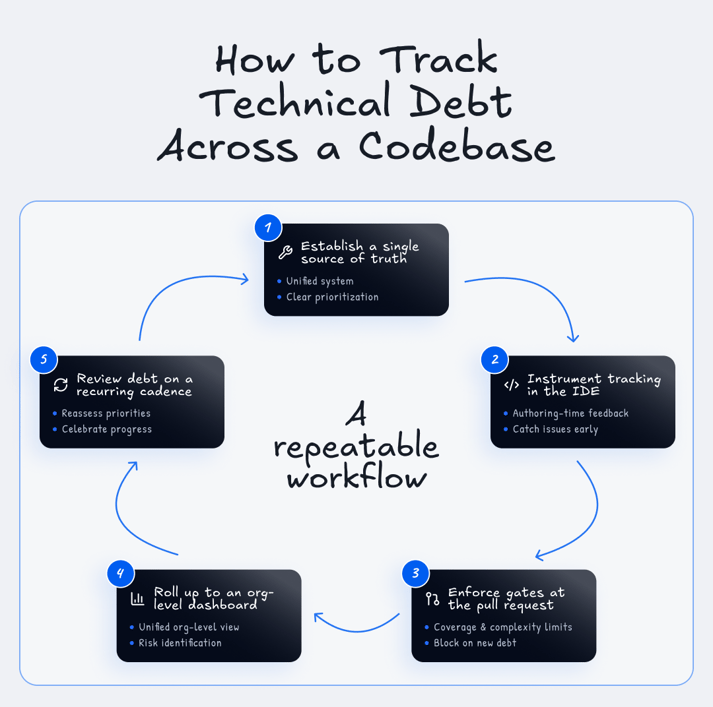
Tracking technical debt works best as a repeatable workflow, not a one-time audit. The goal is continuous visibility, not periodic cleanup sprints that lose momentum after a few weeks.
1. Establish a consolidated source of truth
Consolidate findings from linters, scanners, and manual notes into one system. Scattered Jira tickets and spreadsheets create fragmented visibility that makes prioritization difficult.
2. Instrument tracking in the IDE
Catching issues at authoring time helps surface new debt earlier in the development workflow. IDE extensions that surface debt as developers write code create a feedback loop that is faster than waiting for CI results.
3. Enforce quality gates at the pull request
Blocking or warning on new debt before merge prevents accumulation. Coverage thresholds, complexity limits, and security scans applied at the pull request level catch issues before they compound.
4. Roll up metrics to an org-level dashboard
Leadership needs aggregate trends, not file-level noise. Unified dashboards enable cross-team comparisons and make it possible to identify which repositories or services carry the most risk.
5. Review debt on a recurring cadence
Schedule monthly or quarterly reviews to reassess priorities and celebrate progress. Without a recurring cadence, debt tracking becomes another abandoned initiative.
How to prioritize technical debt
Not all debt is equal. Some is benign and can wait indefinitely. Some is compounding and will cost more to fix next quarter than it does today.
Impact versus effort scoring
A simple matrix works well for most teams: plot debt items by impact and effort, then address high-impact, low-effort items first. High-impact, low-effort wins build momentum for larger remediation efforts.
Risk-weighted prioritization
Factor in security severity, compliance requirements, and blast radius of failure. A code smell in a rarely-touched utility function is a different priority than a vulnerability in an authentication service.
Tying debt to business outcomes
Connect debt items to revenue features, reliability SLAs, or customer pain. When debt remediation is framed as "this will let us ship the Q3 feature faster," it competes more effectively for sprint capacity.
What to look for in a technical debt tracking tool
Manual tracking works for small teams, but it breaks down as codebases and teams grow. The right tooling automates the tedious parts and surfaces the information that matters.
Coverage across quality and security
A tool that detects code smells but ignores vulnerabilities creates blind spots. Look for platforms that cover static analysis, security scanning, dependency issues, and coverage gaps in one place.
Integration with Git and IDE workflows
The best tools connect directly to your Git provider and surface findings where developers already work. If engineers have to context-switch to a separate dashboard, adoption suffers.
Org-wide visibility and reporting
Dashboards that roll up to leadership make it possible to compare teams and repositories. Exportable reports simplify audit preparation and executive communication.
Noise reduction and false positive handling
High false positive rates train developers to ignore alerts. AI-assisted triage or tunable rules keep the signal-to-noise ratio manageable.
Policy and gate enforcement
The ability to set thresholds and block merges ensures consistent enforcement across teams. Without enforcement, tracking becomes documentation without action.
Platforms like Codacy unify static analysis, security scanning, coverage, and AI code governance in one system, replacing fragmented toolchains with a single source of truth for code quality and security.
How AI-assisted development changes technical debt
AI coding tools accelerate code generation, but they can also accelerate debt accumulation if their output is not governed. The same properties that make AI useful for productivity create new tracking challenges.
- Volume: More code means more potential debt surface. A developer using AI assistance might generate three times the code in a day, which means three times the opportunity for shortcuts to slip through.
- Provenance: Attributing authorship becomes harder when code is generated, edited, and regenerated. Traditional review workflows assume a human author who can explain their reasoning.
- Policy gaps: Existing tools may not detect AI-specific risks like unapproved model calls, subtle security or policy issues in generated code, or patterns that reflect outdated training data.
Tracking AI-generated debt requires visibility into which code came from an AI agent and whether it passed quality and security checks. Without that visibility, teams cannot distinguish between debt they chose to accept and debt they inherited unknowingly.
Connecting technical debt tracking to compliance and reporting
Regulated industries require audit-ready evidence of code quality practices. Technical debt tracking, when done systematically, can contribute to audit evidence when paired with existing controls.
Frameworks where debt tracking evidence applies include:
- ISO 27001: Requires documented controls for software development security.
- SOC 2: Includes criteria for change management and code quality.
- HIPAA: Mandates safeguards for systems handling protected health information.
- PCI DSS: Requires secure development practices for payment systems.
- NIST 800-218 (SSDF): Defines secure software development practices for federal suppliers.
Continuous tracking turns compliance from a scramble into a dashboard export. When auditors ask for evidence, the answer is already documented.
Building a technical debt tracking practice that sticks
The teams that succeed with technical debt tracking treat it as a system, not a project. A few principles help:
- Start with visibility. You cannot manage what you do not measure. Even imperfect tracking is better than none.
- Embed tracking into daily workflows. Quarterly audits lose momentum. Pull request gates and IDE feedback create continuous visibility.
- Use tooling that consolidates quality, security, and AI governance. Fragmented tools create fragmented visibility.
- Tie debt reduction to business outcomes. Executive support follows when remediation is framed in terms of velocity, risk, and revenue.
Technical debt is not a problem to solve once. It is a system to manage continuously. The teams that build that system into their workflows ship faster, onboard engineers more quickly, and spend less time firefighting.
Turn technical debt tracking into a continuous engineering practice
Codacy helps engineering teams continuously surface, prioritize, and prevent technical debt with automated quality and security checks embedded in every pull request.
Frequently asked questions about technical debt tracking
How do you track technical debt in agile teams?
Treat debt items as backlog tickets tagged by type and severity, and allocate a fixed percentage of each sprint to remediation. Automated scanning at the pull request keeps new debt from accumulating unnoticed.
What is the 80/20 rule for technical debt?
The 80/20 rule suggests that roughly 80 percent of debt-related pain comes from 20 percent of the codebase. Prioritize that high-impact slice first to get the fastest return on remediation effort.
What is a healthy technical debt ratio?
There is no universal threshold, but many teams aim to keep remediation cost below a small fraction of total development cost. The more important signal is whether the ratio is trending up or down over time.
Should technical debt live in Jira or a dedicated tool?
Either can work, but dedicated tools surface debt automatically from code analysis rather than relying on manual entry. A unified platform that feeds findings into your issue tracker gives you the best of both.
Who owns technical debt tracking in an engineering organization?
Ownership typically sits with engineering leadership or a platform team, but accountability is shared across squads. Clear ownership ensures debt gets prioritized alongside feature work rather than ignored indefinitely.