.svg)
With the growing adoption of agentic development workflows, we’ve seen an increase in SonarQube migrations over the last year, driven largely by AI-assisted development outpacing what a per-line pricing model was built to handle.
In this article, we’ll cover what running more than 300 migrations from SonarQube to Codacy has taught us, the tooling we’ve built to speed up the switch, and the processes we've mapped to ensure a frictionless migration without the risk of disruption.
TL;DR
- The same headcount now ships far more code, so contracted line caps are exhausted mid-contract, forcing renegotiations at a premium and making LoC pricing riskier for AI-assisted development.
- Seat-based pricing decouples cost from code volume, allowing more predictable and consistent cost forecasting.
- Setup itself is a straightforward process thanks to Codacy’s migration playbook, experienced solutions team, and custom migration tooling.
- Hands-on support is a recurring differentiator, especially for large organizations working across multiple teams and complex codebases.
AI coding agents broke SonarQube's Line of Code pricing model
Line of code (LoC) pricing assumes codebase growth tracks headcount: a fixed number of engineers write a fairly fixed volume of code each year, so a contracted annual line cap stays predictable and renewal stays painless. AI coding agents broke that assumption.
Gartner projects that asynchronous AI coding agent workflows will drive 30–50% productivity gains by 2028. A trend that will only punish engineering teams as more lines of code are produced by fewer developers.
For dev teams migrating from SonarQube, this meant steep cost increases and plans hitting their caps months in advance.
The share of new Codacy customers migrating from SonarQube reflects this shift directly: from roughly half historically to about two-thirds in 2026.
After adopting Codacy seat-based pricing, code volume and price are decoupled, avoiding unnecessary cost penalties from adopting modern agentic workflows.
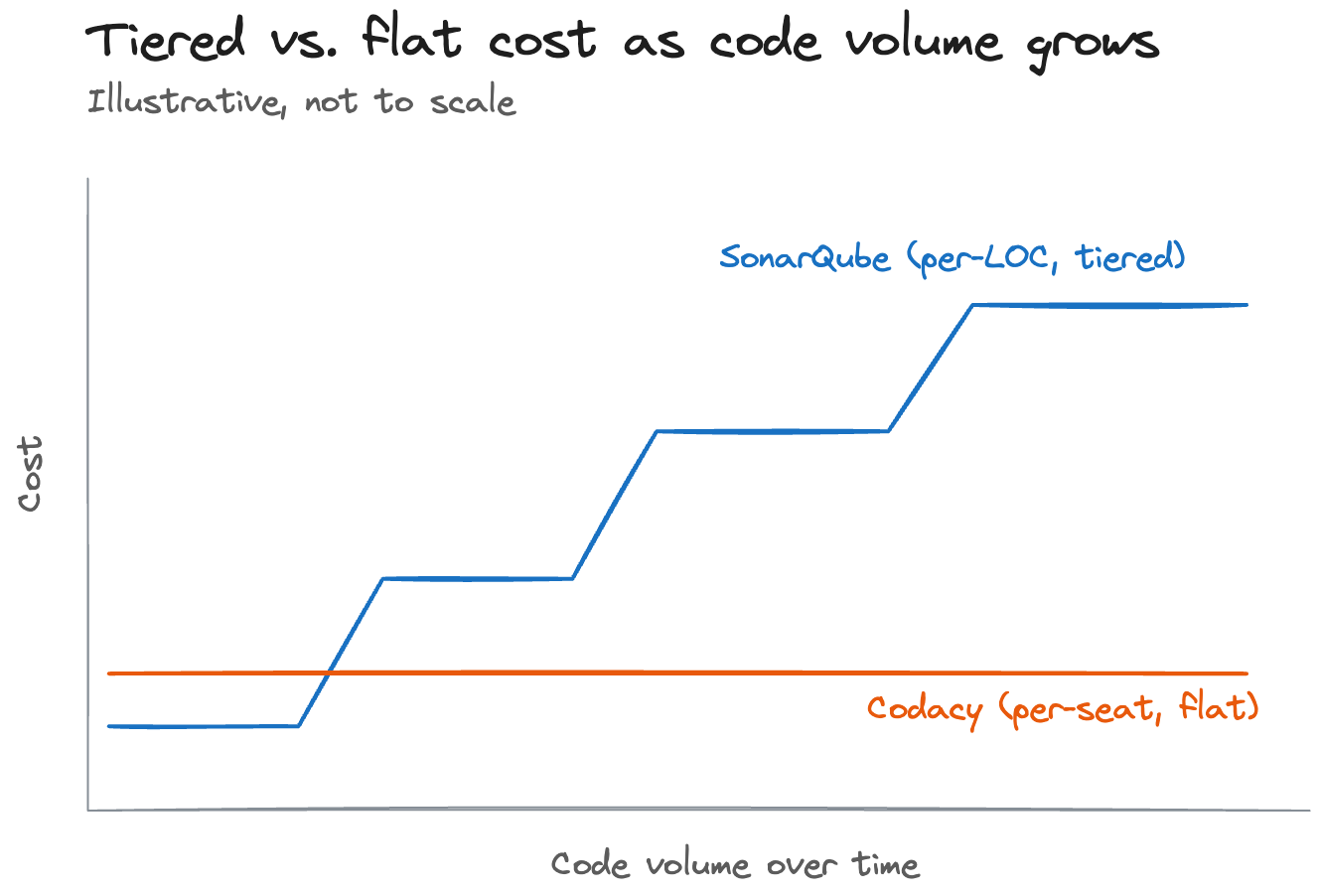
The strategic point for a VP of Engineering: the more engineers ship with AI assistance, the more value they extract from the same seat-based spend, instead of watching cost climb in lockstep with output.
Besides pricing, teams switching to Codacy quickly highlight two things:
- Codacy's roadmap is better aligned with agentic SDLCs: Its tooling is a better fit for an agentic SDLC, thanks to deeper agentic workflow integrations, AI inventory, and smarter AI reviews on every PR, which are critical for the new era of agentic software development.
- Codacy's code quality and security capabilities (e.g., SCA, DAST, Container Image Scanning) allow them to consolidate their stack into a single platform, simplifying their workflows and reducing spending on additional tools.
LSports, a real-time sports data provider, hit these exact walls on SonarCloud: unpredictable per-line costs as their codebase grew, on top of a CI pipeline slowed by required compilation steps.
After moving to Codacy, LSports standardized 800 core repositories under unified quality gates, took unit test coverage from under 7% to 70%, and introduced zero new critical security issues over two years, all while their engineering team grew from 60 to 150 developers.
What migrating to Codacy actually looks like
Based on the size and complexity of the codebase, we typically recommend a phased migration approach rather than a single cutover.
Teams roll out team-by-team or project-by-project rather than switching every repository at once, keeping the risk of any one rollout small and giving the team room to adjust as they expand usage over several days or weeks.
The initial technical setup is fast: authenticate as an org admin, add repositories, and scanning starts automatically, delivering the first scan results within minutes. Because analysis runs on Codacy's side rather than within the customer's pipelines, there's near-zero DevOps configuration required to connect a repository.
The early configuration loop that follows is where the real tuning happens:
- Pick what matters most. The team selects which categories to prioritize across quality, security, and coverage.
- Build a baseline. Codacy runs against the codebase for 1 to 7 days to surface a full picture of current code health.
- Tune together. Through joint review sessions, we walk through the findings and adjust thresholds to the signal that actually matters, ensuring the right coding standards are applied across all projects and narrowing down what Codacy flags.
Node: Codacy's new auto-configuration tunes analysis rules automatically, based on a repository's stack and actual code conventions, helping reduce noisy results from the start.
To minimize migration time, our team has built real tooling and processes around the parts that used to take the longest:
- Scripts port over what's possible from an existing SonarQube ruleset rather than leaving teams to rebuild configuration from scratch.
- For teams already working with a coding agent, Codacy's configure skill tunes rules automatically using Codacy CLI tools, detecting your stack, running a real analysis, and cutting noise based on actual findings rather than a generic default, all in one prompt.
- Similar scripts can automatically swap coverage-upload steps across repositories during cutover, so a fully SonarQube-wired pipeline doesn't have to be replumbed by hand.
- Codacy's setup coverage skill wires up coverage reporting autonomously, based on the test framework and CI system in place.
Codacy terminology is different, but analysis is deeper
Technical setup is a well-documented process, with custom tools built to make it easier. However, in our experience, the biggest driver of a successful migration is helping a team map SonarQube's vocabulary and mental model onto Codacy’s one, which is almost always about how it's described.
That difference shows up immediately in language. Teams arrive speaking SonarQube's vocabulary, using terms like "code smells" because that's the vocabulary they've been using.
This translation is part of the training and enablement sessions, ensuring developers can quickly adopt the new terminology without guesswork. The keyword doesn't carry over. The functionality does.
That said, there’s the other side: learning new concepts and features they didn’t have with SonarQube.
Codacy provides broader functionality, from AI inventory and AI guardrails to agent skills via the Codacy CLI and deeper security analysis (SCA, DAST, license scanning, and container image scanning), bringing new tooling for teams to improve their AI coding workflows and consolidating otherwise scattered solutions into a unified platform.
ihomer, an IT services firm working in the EV and energy transition space, switched to Codacy right after SonarQube changed its pricing model.
Every one of their projects has since migrated to Codacy: duplicate code across key repositories has dropped by 20%, and Codacy AI Guardrails now catches AI-generated code issues before they ever reach a pull request, with zero outstanding critical vulnerabilities at merge time.
Codacy hands-on support is a clear differentiator
Engineering teams moving from SonarQube to Codacy consistently contrast Sonar’s community forum-based support model – where users help other users – with Codacy’s direct, hands-on approach.
While Sonar offers dedicated support as an additional service, Codacy includes it for all business accounts, and for smaller plans, account managers still offer personalized support to ensure a smooth start.
For Codacy users, onboarding looks meaningfully different from a typical vendor relationship:
- Engagement starts during the initial proof of value, with the Customer Success Manager (CSM) understanding each customer’s goals and preferences early on.
- A kickoff session follows to lock in success criteria and map who's involved
- From there, configuration and enablement are handled as a joint effort rather than left to the customer to figure out on their own.
Enablement runs at three levels.
- For developers, it means guided sessions on what to expect and how to use Codacy day-to-day — the kind of walkthrough other vendors often replace with a link to documentation.
- For admins, typically Engineering Managers or DevOps, CSMs run dedicated training sessions on account configuration, the Codacy API, and pipeline integrations.
- For engineering leadership, it means working directly with the CSM to translate migration progress into the metrics and goals that actually matter to the business, so a VP of Engineering isn't left inferring success from gut feeling alone.
As one Codacy solutions engineer puts it, "companies don't buy from companies, people buy from people" — and it's consistent enough across migrations to be one of the more durable reasons people stay once they've switched.
Still on SonarQube?
Through September 2026, we’re offering a free transition period to ease your team’s migration.