.svg)
AI Code Review Cost Per Pull Request: What Engineering Teams Actually Pay in 2026

AI code review costs anywhere from a few cents per pull request to $25 per review, depending on the tool, review depth, and PR complexity.
Claude Code Review from Anthropic runs $15 to $25 per PR based on size and complexity, while GitHub Copilot and Cursor Bugbot now bill on usage rather than a flat rate.
Uber reportedly maxed out its 2026 AI budget in four months after rolling out Claude Code across its engineering organization, with some engineers running up $2,000 a month, which is the kind of number a VP of Engineering has to explain to finance.
This article breaks down what each major AI code review tool actually charges and where a predictable per-seat cost makes more sense than a metered one.
TL;DR
- Per-PR cost for AI code review ranges from near-zero to $25, and the tools with the widest range (Claude Code Review, Cursor Bugbot) are billed based on token usage rather than per seat.
- Review-on-every-push may multiply your bill with every push, because tools such as Claude Code Review can incur a separate usage charge each time the review runs
- A monthly spending cap does not guarantee coverage. It usually means the review gets skipped once the budget runs out, potentially when a large or risky change needs it most.
- Per-review cost and per-seat platform cost answer different questions: one prices a single opinion, the other prices ongoing enforcement across every repository.
AI code review is now a budgeting problem
With GitHub itself acknowledging that a handful of agentic requests can cost more than the underlying plan price, it has become clear that AI code review spend is growing faster than most budgets were built to absorb. The reason, however, goes beyond simple pull request volume.
Teams adopted coding agents like Claude Code and Cursor for developer productivity, not to generate more PRs, but more PRs turned out to be a predictable side effect of writing code faster.
AI adoption also creates a visibility problem. Personal subscriptions, local IDE extensions, and CLI agents can fall outside the visibility of centralized governance and procurement systems. Codacy found traces of 27 different coding assistants across more than 6,700 repositories from more than 800 organizations.
Some teams are now experimenting with adversarial review layers, where a second model checks or challenges the first agent’s output. That adds another round of model inference and, therefore, can increase token consumption.
Uber's experience shows how fast this compounds: according to reporting on the company’s Claude Code rollout, monthly spend per engineer ranged from $150 to $250 on average, with power users reaching $500 to $2,000.
Uber had also built internal leaderboards ranking engineers by usage, a pattern that shows up elsewhere, too: Meta employees also created an internal leaderboard dubbed "Claudeonomics." According to The Information, Meta employees used 60.2 trillion AI tokens over a 30-day period. After The Information reported on the leaderboard and the scale of usage, the leaderboard was taken down.
The common thread is that more AI-assisted development (and increasingly AI code review) is being priced according to model usage. That makes forecasting harder than with a simple per-seat fee.
The question is, therefore, plain: what does AI code review actually cost per month, and can that number stay consistent from one sprint to the next?
What AI code review actually costs: Claude Code, Copilot, Codex, Gemini Code Assist and Cursor Bugbot
Pricing for AI code review splits into two camps: tools billed per seat and tools billed by token usage per review. The table below reflects public pricing as of August 2026.
|
Tool |
Pricing model |
Cost per PR review |
|
Claude Code Review (Anthropic) |
Usage-based, billed in credits |
$15 to $25 per review, scaling with PR size and verification depth |
|
Copilot plan + AI Credits + GitHub Actions minutesGitHub Copilot code review |
Starting June 1, 2026, Copilot code review began consuming GitHub Actions minutes in addition to GitHub AI Credits. The review runs on GitHub Actions infrastructure, so organizations can incur both AI-usage and Actions costs.Bundled with Copilot plan, plus GitHub AI Credits and Actions minutes as of June 1, 2026 |
Variable; consumes AI credits based on token usage, plus GitHub Actions minutes for agentic capabilities |
|
Cursor Bugbot |
Usage-based as of mid-2026, moved off a flat $40/month rate |
Usage-based; typically $1 to $1.50 per run, depending on PR size and complexity |
|
OpenAI Codex |
Usage-based / included with eligible ChatGPT plan |
Token-based; code review consumes Codex usage based on actual model tokens |
|
Gemini Code Assist (Google) |
Per-seat subscription with a two-tier corporate structure (Standard and Enterprise). |
Per-seat subscription |
The widest range belongs to Claude Code Review, which Anthropic prices between $15 and $25 per pull request, depending on how much verification work the reviewing agents do.
Starting June 1, 2026, GitHub Copilot code review uses two billing meters: token consumption is charged in GitHub AI Credits, while the agentic infrastructure powering the review consumes GitHub Actions minutes.
AI code review cost calculator: estimate your team's monthly spend
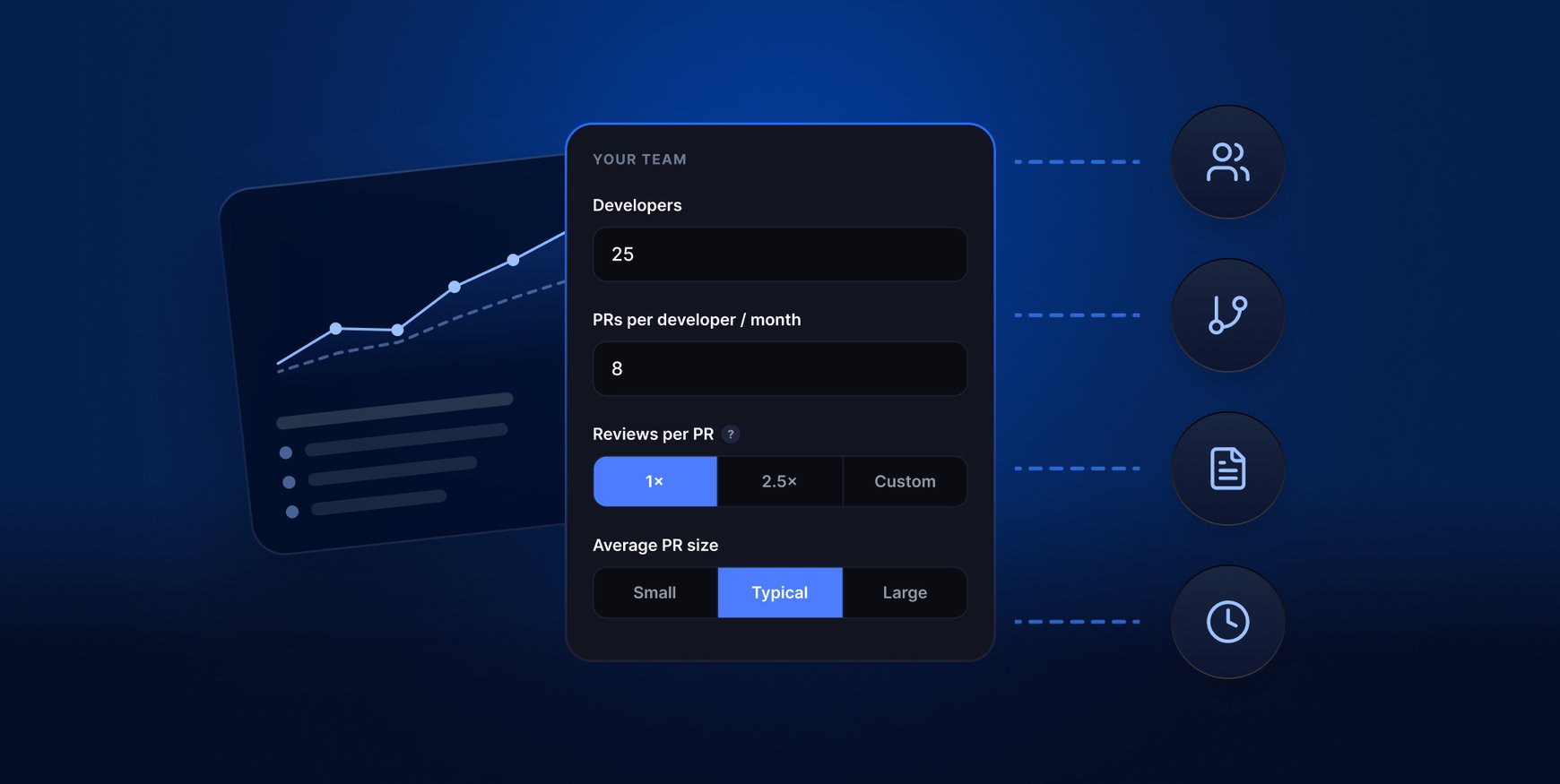
The fastest way to see how these pricing models play out for your own team is to run your numbers through a calculator rather than someone else's averages. Codacy's AI code review cost calculator is built to do exactly that, using the inputs that actually move the bill.
The calculator takes four inputs and projects a monthly spend range across the pricing models covered in this article:
- Team size (number of developers)
- Pull requests opened per developer per week
- Average lines changed per pull request
- Review trigger (on open, on every push, or manual)
What drives your AI code review bill: PR volume, diff size and review triggers
Because it decides how many times a token-based tool runs against the same piece of work, the single biggest lever on your AI code review bill is the review trigger you configure.
A tool set to review on every push re-reviews the same pull request each time a developer pushes a fix, a rebase, or a response to earlier comments, so a PR that goes through six commits before merge can generate six billable reviews instead of one.
That same mechanic works against you on diff size. A 2,000-line refactor, the kind of change that most needs a careful second pass, is also the most expensive one to run through a token-based reviewer, since cost scales with how much code the model has to read and reason about.
Teams may end up rationing review to smaller and lower-risk changes precisely because the expensive option is the one they can least afford to skip.
Cursor's own users have flagged this dynamic directly: when Bugbot moved off its flat monthly rate, developers on Cursor's community forum argued that the new usage-based pricing "punishes iterative workflows and power users", which is a striking admission coming from a vendor's own customer base rather than a competitor's marketing copy.
When metered AI code review pricing is the cheaper option
Metered pricing genuinely wins for teams with low and stable pull request volume, small average diffs, and a review-on-open trigger that never fires more than once per PR.
If your team merges twenty pull requests a month with focused diffs, a per-review charge can beat a flat monthly seat price on pure arithmetic, and there's no reason to overpay for capacity you won't use.
It's also worth remembering that AI code review vendors are increasingly building variable fees into their own models too, so the comparison between "predictable" and "metered" isn't always as clean as picking one column over the other.
And not every check needs a language model running against it in the first place. A hardcoded secret, a SQL injection pattern, or a missing dependency update doesn't require an AI reviewer's judgment; deterministic static analysis catches those reliably and far more cheaply, which is why teams increasingly route the mechanical checks to static analysis and save token spend for the judgment calls AI actually adds value to.
What token-based or metered pricing doesn't buy: quality trends, coverage and technical debt
A per-PR review price and a per-seat platform price are answering two different questions, and comparing them head-to-head misses the point.
AI code review, however it's priced, produces an opinion on one pull request at one point in time. It doesn't tell you whether your test coverage is climbing or slipping across the codebase, whether duplication is creeping back into a service your team touched six months ago, or whether every repository in your organization is actually enforcing the same standard, rather than just the ones where someone remembered to trigger a review.
That last point matters more than it sounds. A $1.20 review on one PR says nothing about the other forty repositories for which nobody configured a trigger.
Consistent enforcement requires a system that runs the same policy everywhere by default, independent of whether an individual developer remembered to ask for a review, which is a governance question rather than a pricing question.
How Codacy prices AI code review
Codacy prices code quality and security, including AI-assisted review, on a predictable per-seat basis rather than metering by token or by PR, combining deterministic static analysis with AI-powered review in one platform.
That structure exists for a specific reason: a number of VPs of Engineering can commit to at the start of a quarter is also a number that lets them mandate review on every push and on the largest refactor of the year without the bill arguing against the policy.
Codacy's breakdown of what changed with GitHub Copilot code review covers the billing mechanics in more detail; this calculator is the interactive layer that piece didn't have, letting you plug in your own PR volume and see the range before you commit to a vendor.
How much will AI code review cost your team?
AI code review can turn into an unpredictable cost as PR volume and review frequency grow exponentially. Codacy combines AI review with automated code quality and security checks on a predictable per-seat basis.