.svg)

Most engineering leaders running AI code reviews can point to a clean PR history and still not answer the one question that actually matters: is the codebase, as a whole, getting safer?
Every individual pull request gets reviewed, commented on, and merged looking fine. But ask a VP of Engineering whether security findings are being resolved faster than new ones show up, or whether the same quality bar is holding across all fifty repositories, and the answer is usually an educated guess lacking the necessary audit trail to support it.
This article looks at the limitations of PR-level AI code review, and what a governance layer above it actually needs to do.
TL;DR: PR-level review and governance across repositories
AI PR reviewers judge one diff at a time, which is useful for catching bugs before merge, but can't tell you whether your codebase is getting safer over time. A governance platform provides engineering leadership with a persistent record across the entire fleet of AI code reviewers.
AI code review is everywhere now
Tools like CodeRabbit, GitHub Copilot's native review, Claude Code Review, Cursor's BugBot, and Greptile all do the same core job: read a diff, generate a comment, and sometimes block a merge before a human reviewer opens the tab.
This is a necessary process for teams to handle the volume AI-generated code workflows are producing, and we’re not here to question its importance. However, what truly matters for governance is scope.
Each of these tools judges one change at one point in time, using whatever context fits inside its window. None of them, by design, answers a longer question: as this codebase accumulates thousands of these individual judgments across dozens of repositories, is it actually getting more secure, more maintainable, and easier to audit?
That is the question any good VP of Engineering has to answer. On the other end, it is, unfortunately, not the question a PR reviewer was built to answer.
Why PR-level AI code review isn’t the same as codebase governance
PR-level AI review operates on one change, one branch, and one point in time, which makes it useful for catching an obvious bug before merge, but it remains structurally unable to tell you where the codebase is heading.
Codebase governance, by contrast, is the practice of tracking whether quality, security, and coverage standards are being held consistently across every repository and team over weeks and quarters, not just within a single diff.
A reviewer working inside a pull request has no visibility into what happened in the other forty repositories your organization maintains, and no memory of what it flagged last quarter. That narrow scope is fine for helping one developer ship a clean change. It cannot, however, answer the questions that actually determine whether an engineering organization is under control:
- Is test coverage increasing or declining across the portfolio this quarter?
- Are security findings being resolved faster than new ones are introduced?
- Which repositories are quietly accumulating the most technical debt?
- Could the team produce evidence tomorrow that quality and security gates were enforced before every release?
A team can run CodeRabbit, Copilot, Claude, or Qodo in parallel and still need a separate layer that answers those questions, because the governance layer has to be independent of whichever assistant happens to comment on an individual PR.
Your AI reviewer can help with the conversation inside that PR. It cannot, by itself, become the operating system for code quality, security, and coverage across the company.
What engineering leaders should actually be asking
Teams relying solely on the AI reviewer layer are forced to focus on PR-level questions:
- Did the reviewer catch a bug in this diff?
- Did it produce helpful suggestions?
- Was the comment accurate enough for the developer to trust?
Those are fair questions for a developer to ask about the tool in front of them. They are not, however, the questions that tell leadership whether the organization is under control.
At the PR level, the narrative is about which AI reviewer catches the most bugs on this week's changes. For governance, however, A VP of Engineering needs a different set of answers:
- Is the codebase getting safer over time?
- Do the same quality and security policies hold in every repository?
Both sets of questions matter. But answering the second set requires a system built to track state over time, not a stream of comments that vanishes once a branch merges.
Why per-PR AI accuracy alone can’t be a governance strategy
The main reason per-PR AI accuracy alone can’t be a governance strategy is that even the strongest AI reviewers still miss a meaningful share of real issues and generate a meaningful share of comments developers never act on.
Martian's Code Review Bench, built by a research lab staffed by people who previously worked at DeepMind, Anthropic, and Meta, evaluated 17 AI code review tools against real developer behavior across more than 1.2 million code changes from GitHub PRs.
Rather than grading tools against a curated list of planted bugs, the benchmark asked a much harder question to answer: “Did the developer actually change their code after the bot's comment?” The scoring mechanism measures precisely whether suggestions result in actual code changes rather than whether the comment sounded plausible.
The results are a useful reality check for anyone treating a PR bot as sufficient enforcement. Across that dataset, the best AI code review tools achieve F1 scores in the 50-60% range (July 2026).
In other words, roughly half of the real issues in a codebase still slip past even the top-ranked tool, and roughly half of what gets flagged doesn't move the developer to change anything.
Two structural limits follow directly from that number:
- First, accuracy has a sufficiently low ceiling that a PR reviewer cannot be the sole control standing between AI-generated code and production.
- Second, trust in the tool depends on precision—Stack Overflow's 2025 survey found 33% of developers trust AI output—and once developers start seeing enough comments that don't hold up, they stop reading the thread altogether, at which point the review is present in name only.
None of this is an argument against AI code review. A comment stream that disappears the moment a PR merges is a useful conversation, but it is not a system of record, and governance requires the second thing.
What happens when AI code review reaches real scale?
Once an organization runs an AI review across thousands of repositories—just as an example of the scale we’re talking about, GitHub Copilot processed over 60 million code reviews from April 2025 to March 2026—, engineering leaders need to start asking "how do we aggregate, deduplicate, and enforce policy across everything the model has said?" and not simply “what does the model say about this diff?”
Cloudflare's own build-out of AI review is the clearest public illustration of this shift.
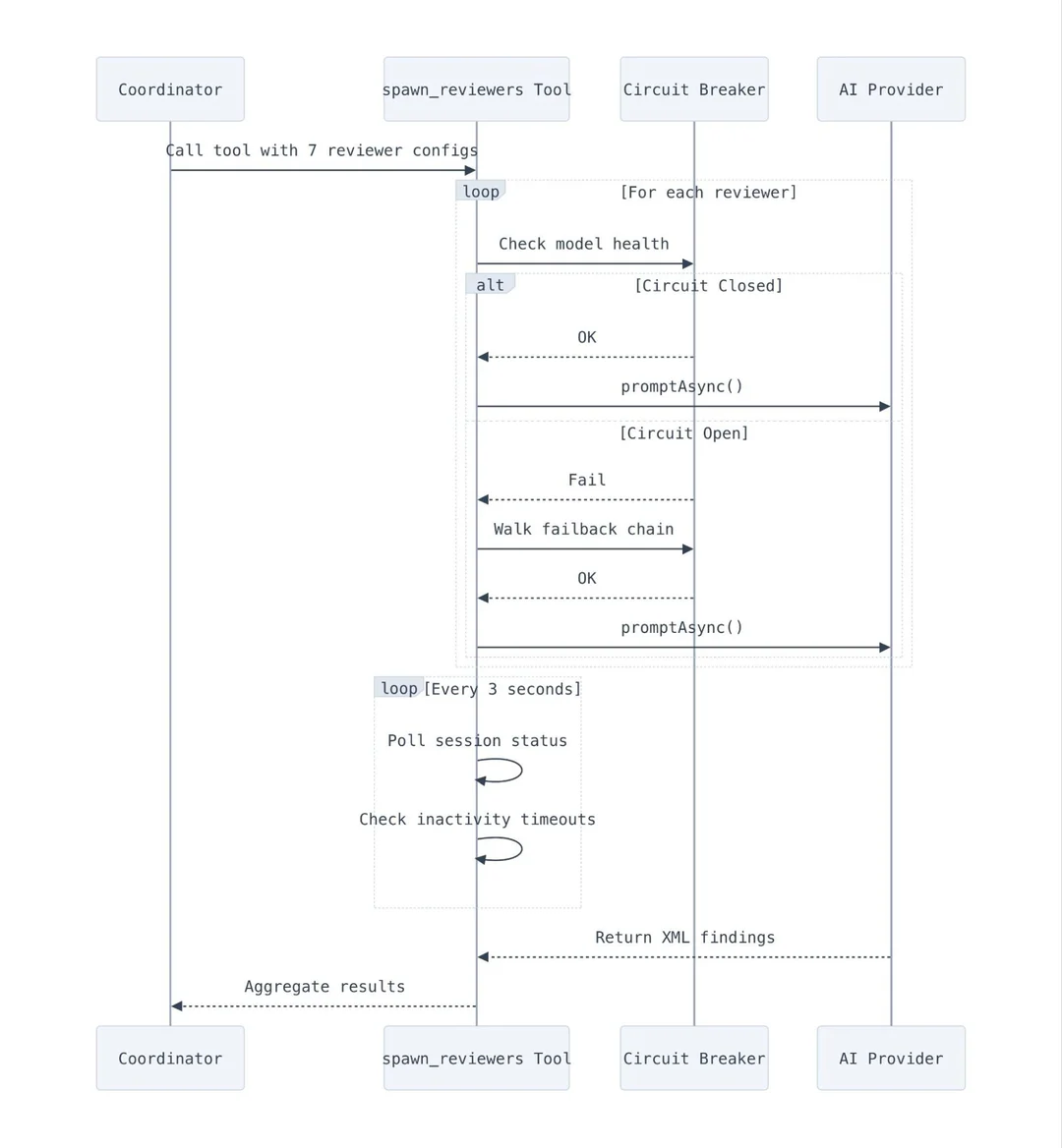
Source: Cloudflare
Rather than relying on one generic model, the system launches up to seven specialized reviewers per pull request, covering security, performance, and code quality among other domains, then hands their output to a coordinator agent that deduplicates overlapping findings and assesses actual severity before posting a single comment.
Multiply that by thousands of repositories, and the operational problem stops being about any individual review and becomes about the fleet:
- Reconciling findings across services
- Tracking which issues are aging
- Proving to a compliance team that the gates are actually held at release time
That transition, from assisting one PR to governing an entire portfolio, is exactly the point where PR review and codebase governance become distinct disciplines.
What does a code governance layer provide?
A code governance layer needs to answer whether standards are holding across the entire system. In practice, that means tracking trend lines instead of individual events, and enforcing the same threshold in every repository rather than leaving it to each team's discretion.
Consider a common failure mode:
Individual pull requests all look fine on their own, each AI code reviewer comments on the implementation details in front of it, and coverage still slides across a handful of repositories over a quarter because no single PR crossed a visible line.
Leadership typically notices only when defect rates start climbing in production, well after the trend has quietly established itself.
A code governance layer catches that decline early because it is watching the trajectory, not the moment.
|
Governance function |
What it needs to deliver |
|
Organization-wide visibility |
Security findings, quality trends, and coverage movement broken out by repository and team. |
|
Consistent enforcement |
The same quality and security thresholds applied everywhere, not just in the repos a given team happens to police. |
|
Longitudinal tracking |
Trend lines over weeks and quarters, resolution rates, and aging findings distinguished from new debt. |
|
Release and compliance evidence |
Proof that gates were enforced before merge, with exception handling that expires rather than being forgotten. |
Do AI PR Reviewers and Code Governance Platforms Solve Different Problems?
What most engineering leaders miss is that AI PR reviewers and governance platforms are not competitors. The decision is not whether to use one or the other. This reasoning misses how they actually fit together.
An AI PR reviewer assists the individual developer inside the pull request. A governance platform helps the engineering leader manage standards across every repository that developer and every other developer touch.
A useful way to see the difference in practice is to observe how a security scenario plays out across 50 repositories, where each pull request introduces only one or two low-severity findings. No single change looks serious enough to escalate on its own, yet the unresolved findings age and compound across the portfolio until they represent real exposure.
A PR-level reviewer has no way to see that pattern, because it never looks past the diff in front of it. A governance layer built to aggregate findings across the fleet is the only place that pattern becomes visible.
Where Does Codacy Fit as the Code Governance Layer?
Codacy sits above whichever AI code reviewer a team already uses and turns each individual finding into a persistent record rather than a comment that disappears at merge.
This is the concrete mechanism worth understanding:
- When a standalone code reviewer like Claude Code Review or Copilot comments on a pull request, that comment is the entire artifact. It lives in the PR thread, and once the branch merges, nothing about that finding rolls into any ongoing measure of the codebase's health.
- When Codacy reviews the same pull request, the finding is written into Codacy's own data layer at the same time it appears as a comment, tied to the specific commit, counted toward that repository's current quality and security state, and carried forward in the historical trend for both the repository and the organization. The same event becomes two things at once: a comment the developer sees immediately, and a data point leadership can query months later.
That distinction is what lets Codacy provide fleet-wide visibility, consistent quality gates, and longitudinal reporting without requiring a team to abandon the reviewer they already trust for PR-level feedback.
It also underpins the compliance evidence regulated teams increasingly need, since frameworks like ISO 27001 and SOC 2 require proof that gates were enforced, not just that a bot commented somewhere along the way.
Fill the governance gap your AI code reviewer alone can't.
Codacy tracks quality, security, and coverage trends across every repository your team owns, so the next question your leadership team gets asked has an answer already sitting in a dashboard.