
AI-native SDLC: how to get there without rebuilding your development process in 2026

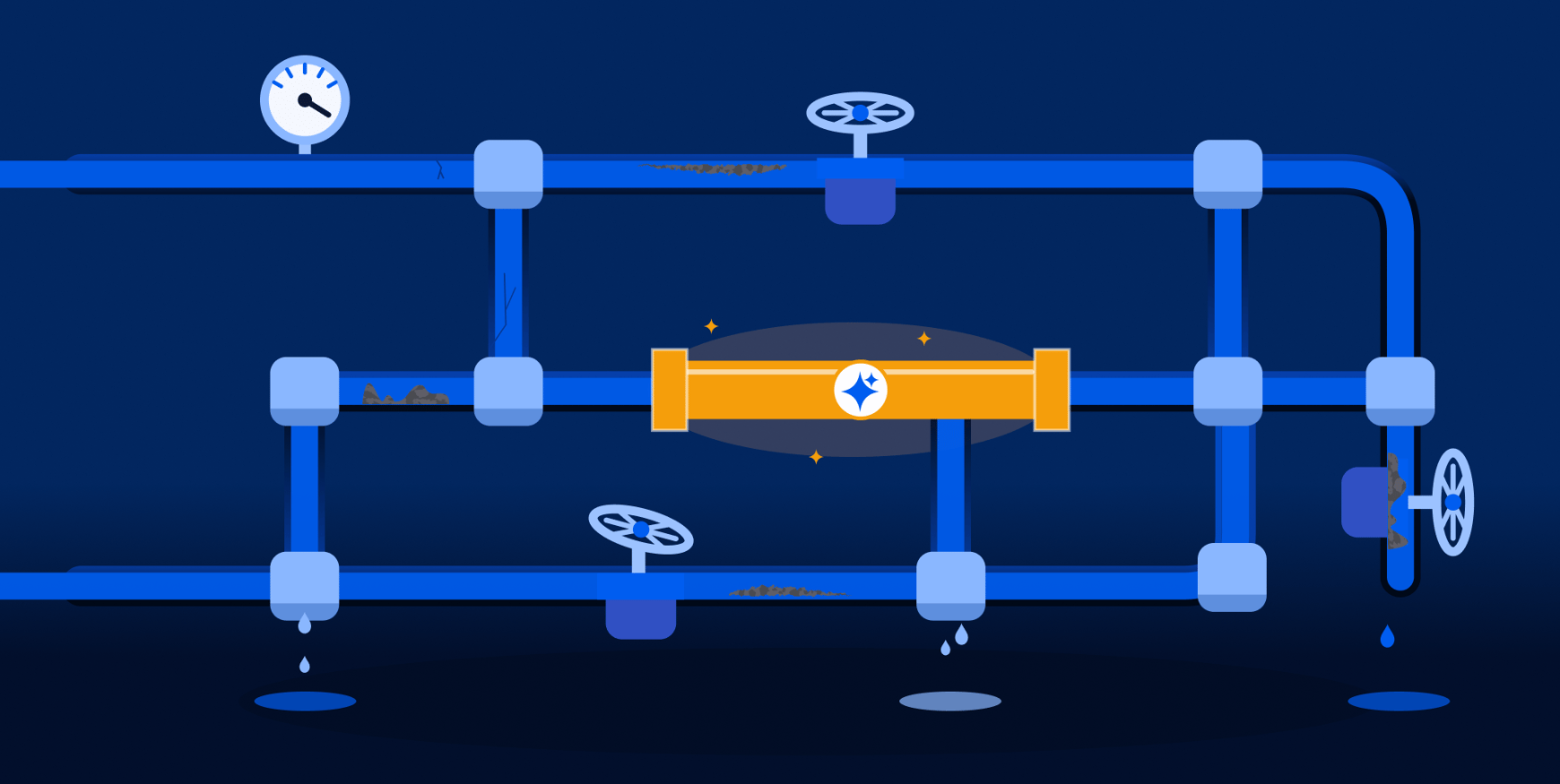
Your team gave every developer a coding agent, and code now arrives faster than anyone can review it. However, the SDLC around the agent still runs at human speed, so the bottleneck moves to planning, review, and deployment.
Atlassian shows what changes when those stages speed up too, with issue cycle time falling from 11.5 days to 6.7 days.
An AI-native SDLC is a software development lifecycle in which automated verification keeps pace with how fast coding agents generate code.
In this article, we'll cover what changes at each stage of the SDLC and where human judgment should stay.
Key takeaways
- An AI-native SDLC keeps Jira, GitHub, and CI/CD as the system of record and adds verification at the point of change.
- Coding agents speed up one step, so the bottleneck moves to planning, review, and deployment, which still run at human speed.
- Standards enforcement, security checks, and review break first: reviewers now verify work they didn't watch, at a volume no team can hire its way through.
- Governance has to be executable. If a check is optional, the agent skips it, so hooks and merge gates replace advisory documents and sign-offs wherever a rule can decide.
- Agents act up to the gate, and people decide at it, which keeps scarce senior review time on the changes that carry real risk.
Adding AI to individual steps is not the same as redesigning the SDLC flow
An engineering team can put a coding agent in every developer's terminal and still run an SDLC designed for a world where writing code was the slow part. The agent speeds up one step and leaves the rest of the flow untouched.
Most teams that adopt AI coding agents start exactly here: a faster way to produce a diff, dropped into the same intake process, review queue, approval gates, and sprint rituals that existed before the agent arrived.
When writing code collapses from weeks to hours, the steps whose delays used to go unnoticed become the visible constraint, because planning, review, and deployment still run at the pace of human meetings and human attention rather than the pace of agent output.
The bottleneck in the AI software development lifecycle relocates to those steps.
Reviewing a diff line by line made sense when a person had written every line, and a reviewer could reasonably assume the author understood the trade-offs behind each choice.
That assumption breaks down once an agent writes most of the change. The reviewer is now verifying work they didn't watch happen, at a volume no manual process was sized to absorb. This is what DORA calls the verification tax.
Agent output grows faster than any engineering organization can add reviewers, so no team can hire its way to that review volume. The way forward is to adapt the SDLC around the agent, so each stage produces work a machine can check, and people step in only where judgment is needed.
What an AI-native SDLC changes at each stage
The widely cited six-stage model from Anthropic's AI-native SDLC playbook gives engineering teams a shared vocabulary for this shift:
Plan: capturing intent so agents start from the right place
Planning in an AI-native SDLC means replacing drawn-out backlog rituals with a short, committed statement of intent that both a person and an agent can read and act on.
When that intent instead lives scattered across meetings, Slack threads, and half-written tickets, an agent starts from ambiguous inputs and generates volume in the wrong direction, which is often more expensive to unwind than no code at all.
This is the one stage where a verification layer should stay entirely out of the way.
Design: defining standards once so they apply everywhere
Design is where a team defines the standards a change must meet before any code gets written, so an agent working from the spec already knows the rules rather than discovering them in review.
When those standards live in a wiki page nobody rereads, or in one reviewer's memory, they get applied inconsistently from repo to repo, and that inconsistency compounds as code volume rises with agent adoption.
This is where a centralized policy engine earns its keep. It should let a team define coding standards and AI policies once and apply them consistently across all connected repositories and all agent-generated changes, rather than each team reinventing its own interpretation.
Build: checks inside the IDE and the agent's loop
During the Build stage, an agent explores a repository, drafts a plan, and edits multiple files in a fraction of the time that work used to take a person.
The problem is that if checks run only after the fact, an agent can produce a large diff with no feedback until it hits the review queue, and that queue backs up quickly once several agents are working in parallel.
Closing that loop requires quality and security checks that run in the IDE and in the agent's working session, so issues surface and get fixed while the agent is still working rather than after a human finally opens the pull request.
Test: coverage that keeps pace with generated code
Testing has to treat coverage as continuous rather than a separate phase tacked on at the end of a sprint.
When build velocity accelerates but test coverage doesn't keep pace, untested generated code quietly piles up, and the risk simply moves downstream to whoever discovers it in production.
Coverage tooling should tie coverage directly to the change itself, flagging untested lines in a diff before merge instead of leaving a team to discover them weeks later through an incident.
Deploy: quality gates and AI review at the pull request
At the Deploy stage, review and approval account for the largest chunk of human-speed time left in the pipeline.
CloudGeometry's analysis of the public Anthropic playbook makes a point worth raising: the real ceiling on how many agent sessions a team can run is the number of changes a person can properly review before quality erodes.
Independent quality gates should block a PR from merging when it introduces new quality or security issues, so the merge gate enforces consistently regardless of which reviewer is on call that week.
AI code reviewers, on the other hand, must flag what needs a closer look, so human attention goes toward judgment calls instead of mechanical checks.
Maintain: codebase-wide visibility over time
Maintaining an AI-native SDLC means keeping a live view of quality and security trends across every repository, as the codebase changes rapidly. Without that shared view, drift stays invisible until an incident forces someone to go looking for it.
At Atlassian, for example, agent loops in Jira now resolve 51% of potential vulnerabilities automatically.
A shared view should surface recurring issue classes and standards adherence across all connected repos rather than on a per-project basis.
Codacy as the verification layer across these stages
Codacy provides that verification layer across the stages where it fits, letting teams switch this layer on rather than building hooks, eval pipelines, and policy configuration from scratch:
|
Stage |
How Codacy fits |
|
Plan |
Planning stays with your existing tools. |
|
Design |
Codacy Skills give coding agents the same coding standards and gate policies your team defines once at the organization level and applies to every repository. |
|
Build |
AI Guardrails runs quality and security checks in the IDE and inside the agent's session through the Codacy MCP Server. Verity reviews every agent turn through a stop hook: the Codacy Analysis CLI runs deterministic checks first, then an independent model reviews the session, with up to two self-fix attempts before it hands off to a person. |
|
Test |
Coverage tracks coverage against each diff, and coverage rules in quality gates flag untested changes before merge. |
|
Deploy |
Codacy's quality gates block merges that introduce new quality or security issues, while Codacy's AI Reviewer reviews each PR and flags what needs human attention. |
|
Maintain |
AI Risk Hub gives codebase-wide visibility into recurring issue classes and standards adherence across every connected repository. |
Note: Everything here covers work up to the merge. Planning, release orchestration, and production monitoring stay with your existing tools.
From handoffs and approvals to artifacts and automated gates
The handoff itself changes shape in an AI-native SDLC: committed, machine-readable files that both agents and people can read replace meetings and status tickets as the way work moves from one stage to the next.
Each stage leaves behind a file the next stage can pick up, such as an intent note, a spec, a plan, or a diff with its test results.
What teams need are gates that replace sign-offs wherever a rule can decide, so a lint violation, a known vulnerability pattern, or an untested changed line gets the same deterministic check every time.
Where human judgment still belongs in the SDLC
Not everything in an AI-native SDLC should get automated away, and the line sits where context and accountability matter more than pattern-matching.
People still own intent, risk tradeoffs, and anything touching regulated data or business-critical logic, as no rule-based system can substitute for someone who understands why a decision matters to the business.
The operating model worth adopting is simple to state: agents act up to the gate, and people decide at it.
The verification layer validates everything it can first, and humans step in only where the system genuinely can't make the call, while remaining accountable for production decisions.
In other words, it means concentrating scarce senior review time on the handful of pull requests per week that touch something sensitive, and letting the gate clear everything else a rule already covers without waiting on a human in the loop.
What can teams change without rebuilding their SDLC?
A team doesn't need a platform rebuild to make its SDLC AI-native. It needs to keep its existing tools as the source of truth where auditors already expect them and start enforcement at the stages that hurt most once agents write the code.
- Keep Jira, GitHub, and CI/CD as the system of record. Don't rip out tools auditors and other teams already depend on.
- Link records to commits so the artifact trail stays intact and auditable from intent through merge.
- Start with the verification layer at the stages that break first: review, security checks, and standards enforcement.
A team switches on enforcement at the point of change and expands coverage from there as confidence builds.
Why does governance have to become executable?
Instruction files and process documents describing how code should be written are advisory, and rules that are defined but not enforced don't survive contact with the volume of change agents now produce.
As we found running our own agents, if a check is optional, the agent skips it, because nothing forced the check to run.
Policy still matters: DORA's research shows organizations with clear AI acceptable-use policies see 451% higher AI adoption. Writing the policy down is where it starts; enforcing it is what makes these policies hold.
Hooks and merge gates make policy enforceable. The more manual gates a team keeps on the critical path, the more backlog and review overhead accumulates as agent output scales, which is precisely the governance tax a verification layer is built to remove.
Executable gates also produce the evidence AI code governance depends on. Once a meaningful share of new commits come from agents, a team needs a record of which tests and checks ran on each change, one of the basics of governing AI in software development.
Agents act up to the gate. Build the gate.
Codacy applies your standards, security checks, and quality gates in the IDE and on every pull request, so review keeps pace with agent output.
FAQs around AI-native SDLC