.svg)
Does Your Engineering Team Have a Parallelization Strategy for AI Coding Agents 2026?

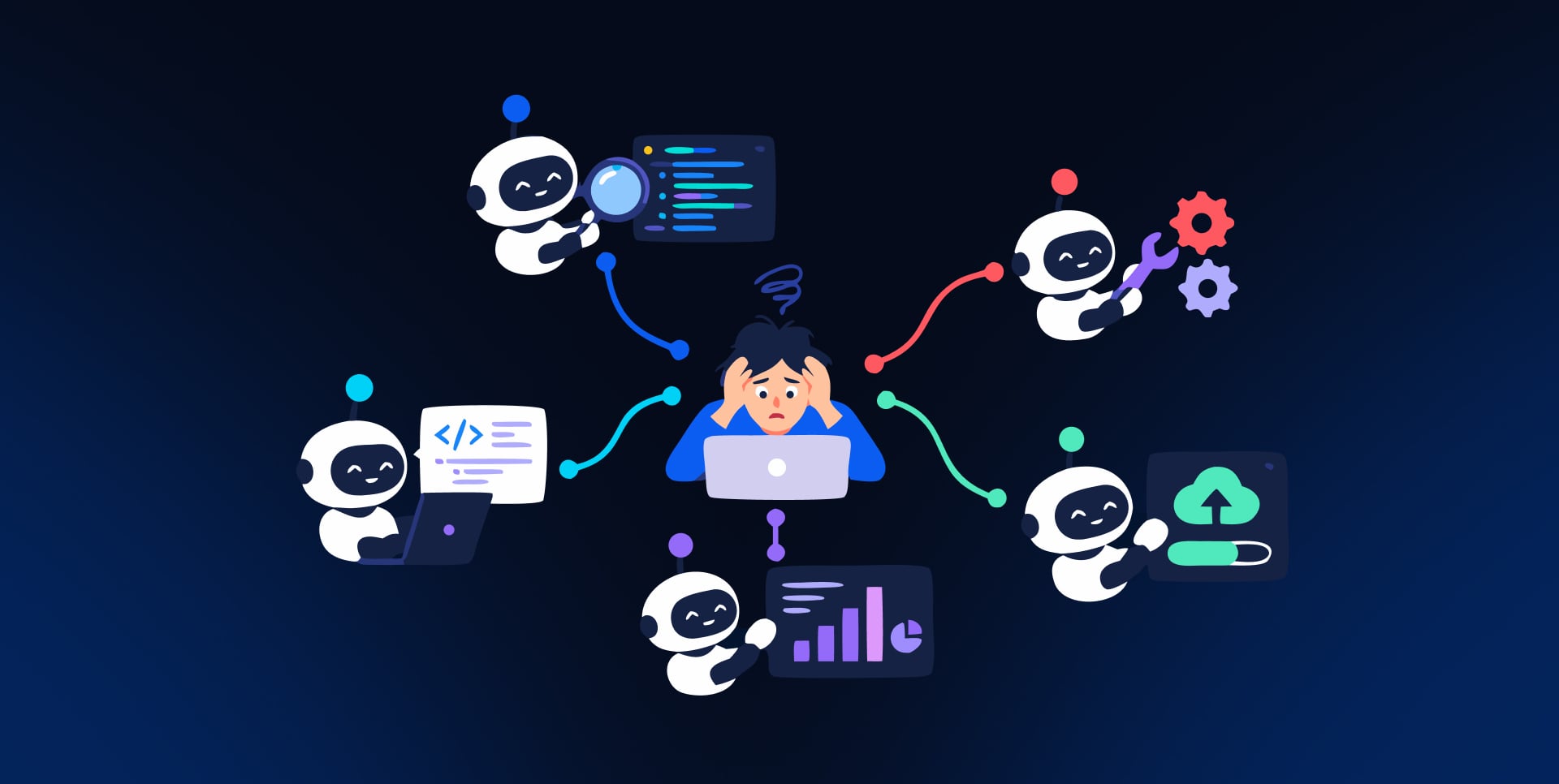
You have three coding agents running. One is refactoring a service, another is fixing a bug, and a third is writing tests. So you start a fourth.
This is becoming a normal way to work with tools like Claude Code and Codex. Simon Willison has written about running four agents in parallel, often on separate worktrees. But there’s a catch: you can parallelize the work faster than you can parallelize your attention. Willison notes that he can still only focus on reviewing and landing one significant change at a time.
That raises a less obvious question about AI coding agents: what happens after they finish?
As the number of parallel sessions grows, so does the work of keeping context straight, reviewing changes, resolving conflicts, and integrating the results. Anthropic’s own experiments with parallel Claude instances point in the same direction: running agents concurrently is increasingly practical. Making that concurrency work well inside a real engineering team is a different problem.
Before your team starts running five agents at once, it’s worth asking whether you have a strategy for everything that happens around them.
TL;DR
- The bottleneck in parallel AI coding agent workflows has shifted from typing speed to human attention and verification capacity over raw agent throughput.
- Isolating each agent session in its own git worktree or checkout prevents simultaneous filesystem collisions, keeping each stream isolated until integration.
- Independent work with no shared state parallelizes cheaply; work that touches shared modules like auth or billing incurs coordination overhead that offsets the speed gains.
- Merge and integration, not the coding step itself, is often where the actual time cost of running multiple agents shows up.
- Consistent automated checks applied equally to every parallel stream matter more than any individual engineer's ability to track four or five sessions in their head.
What Changes When One Engineer Runs Four or Five Sessions?
Engineering teams are currently undergoing a transition that focuses on what will happen when attention becomes the new ceiling and code generation ceases to be the limiting factor.
For most of software engineering history, an engineer's throughput was bound by how quickly they could type, think through an implementation, and debug it.
AI coding agents have largely removed the constraint of manually writing code, and once that constraint disappeared, engineers noticed a second, more interesting problem: an agent works autonomously for several minutes at a stretch, and during that stretch a human has nothing to do but wait.
That idle time is precisely why parallelization emerges organically rather than as a deliberate strategy at first. An engineer fires up a Claude Code session, watches it start working, and rather than sit idle for the next four minutes, opens a second terminal and starts a different task.
Engineers now run multiple coding agents at once, firing up several Claude Code or Codex CLI instances at the same time, sometimes in the same repo and sometimes against multiple checkouts or git worktrees. A third session follows soon after, then a fourth, and what began as filling small gaps in a day turns into a standing practice of running several agents concurrently.
This creates two distinct problems that compound rather than cancel each other out.
- A context-management problem: An engineer running four sessions has to keep four separate mental models current, remembering what each agent was asked to do, what it has produced so far, and what still needs deciding.
- A verification problem: More concurrent output does not mean more concurrent scrutiny; a single person still has one set of eyes.
Anthropic engineer Sid Bidasaria described running several agents at once during work on Claude Code itself, and reported that having a few agents running throughout made him more productive.
However, productivity gains of this kind only hold if the review step keeps pace. DORA found that a 25% increase in AI adoption correlated with a 7.2% decrease in delivery stability, partly because faster generation leads to larger batch sizes that are harder to review.
For engineering leaders watching this trend take hold on their teams, the uncomfortable truth is that throughput on paper goes up while the individual engineer's attention still has to physically move from one stream to the next, and that movement is not free.
Why Context Management Becomes the Core Skill
Context management, in this setting, means the discipline of keeping each parallel effort's state, goals, and history straight without losing track of what any single thread is doing.
In single-track development, the operating principle was almost the opposite: minimize context switching, because sustained programming work is cognitively demanding and every interruption costs real reconstruction time to get back to a working mental model.
Parallel agent work inverts the daily rhythm without removing the underlying cost. The switching is no longer accidental, caused by a Slack message or an unplanned meeting; it is now a structural feature of the workflow itself, happening dozens of times a day by design.
The practical answer that experienced practitioners have converged on is structured context switching, which treats each parallel effort as a labelled thread with its own branch, its own defined scope, and its own connection to a specific outcome.
Rather than bouncing between agents based on whichever terminal happens to have new output, an engineer works through a short, deliberate list of active threads, checking each one's status before moving to the next.
A well-defined thread, in practice, needs a few things to function as a stable unit an engineer can pick up and set down without losing the plot.
- A clear label that identifies what the thread is for at a glance, so returning to it after an hour doesn't require re-reading the whole conversation history.
- A defined scope that bounds what the agent is allowed to touch, preventing one thread's changes from bleeding into territory another thread depends on.
- Its own branch or worktree, so the thread's work stays physically isolated from every other thread running at the same time.
- A connection to a concrete outcome, so the engineer can judge quickly whether the thread is done, stuck, or has drifted from the original intent.
There is a plausible advantage for senior engineers here: many already spend their days juggling code review, active coding, interruptions, and multiple workstreams. This advantage does not automatically transfer to less experienced engineers, though, and leaders should be cautious about assuming a four-session workflow scales evenly across a team.
The failure mode of this approach is much more likely to occur for a newer engineer dealing with four unlabeled, loosely scoped threads at once: quiet fatigue, dropped threads, and work that silently stalls because no one was paying close enough attention to notice.
Which Tasks Parallelize Well, and Which Create Coordination Overhead?
Independence is what makes parallelization genuinely cheap, and its absence is what turns four fast-moving agents into four sources of merge conflict.
Work that touches separate services, separate repositories, or modules that share no runtime state can run concurrently with almost no coordination tax, because nothing one agent produces can invalidate an assumption another agent is relying on.
The moment two parallel streams touch overlapping code inside the same application, though, that independence disappears, and the streams start to collide in ways that are expensive to untangle after the fact: one branch might rename a function another branch calls, or a shared configuration file gets edited twice with incompatible intent.
The clearest way to see this distinction is to compare good and poor candidates for concurrent agent work.
|
Good candidates for parallel work |
Why it works |
|
Independent modules or microservices |
No shared state means no collision surface between streams |
|
Separate repositories |
Physically isolated by definition; nothing to merge against |
|
Boilerplate and scaffolding |
Low-risk, mechanical, easy to verify quickly |
|
Test generation for existing code |
Reads code without changing production logic |
|
Isolated refactors within one file or class |
Contained blast radius if something goes wrong |
|
Research or exploration tasks |
No intention to merge the output at all, so there is nothing to conflict with |
|
Poor candidates for parallel work |
Why it creates overhead |
|
Multiple features touching shared auth or billing logic |
Both streams depend on the same contract, so one change breaks the other's assumptions |
|
Work racing an in-flight refactor |
The ground is moving under both branches at once |
|
Anything requiring tight sequencing |
One step must complete and be verified before the next can safely start |
Pull requests and deployments carry their own sequencing constraints regardless of how many agents are producing code, since a release still has to go out in a defined order and some database migrations still have to land before the code that depends on them.
Running six agents in parallel does not shorten the parts of the critical path that are inherently serial. It only changes how much work is queued up and waiting when that serial bottleneck is finally reached. The actual skill in parallelizing agent work, then, is choosing deliberately what belongs in the concurrent lane and what has to stay in line.
How Parallel Streams Change Pull Requests, Review, and Integration
Parallel production concentrates pressure downstream, at the exact point where review capacity has not grown to match the new volume of output. If four agents each produce a pull request in the same afternoon, that is four pull requests arriving against the same single reviewer who was previously reviewing one pull request at a time from their own manual work.
The math does not favor the reviewer, and the failure modes that show up here are specific and recognizable: two agents editing the same file without either one aware of the other, an agent reporting a task complete while its test suite is failing, or a defect that surfaces only after three more commits have already stacked on top, creating technical debt that is harder to trace back to the broken change.
The most consequential shift is what happens to review depth once one person is simultaneously the orchestrator of several streams and the sole reviewer of all their output.
Attention is a fixed resource, and splitting it five ways means each individual pull request gets a thinner pass than it would have gotten if it were the only thing on that engineer's desk that day. This is not a hypothetical risk; it is the direct, mechanical consequence of holding orchestration and review in the same set of eyes without anything else carrying part of that load.
Integration absorbs a share of this pressure too, and often a larger share than the coding step itself. Cursor's own product changes are a useful signal here: when Cursor rebuilt its interface around parallel agents, the company built tooling specifically to aggregate diffs across files for faster inspection, because as AI agents take on more coding workload, new bottlenecks emerge primarily around reviewing code and testing changes, which Cursor addressed by making it easier to quickly review the changes an agent has made.
Conflict resolution, in other words, is frequently where the actual time cost of running parallel agents gets paid, not in the minutes the agents spend generating code. DORA describes this pattern as productivity lost to downstream disorder when coding speed gains are swallowed by bottlenecks in testing and review.
This reality sets up the real requirement for any team serious about this workflow: verification has to be consistent across every stream, applied the same way regardless of which engineer is orchestrating or how many sessions they happen to be running that day.
What Teams Can Put in Place So Concurrency Doesn't Just Create More Work
The goal for engineering leaders is a system of consistent enforcement at the point of change, not a set of habits that only work as long as one engineer keeps every thread straight in their head.
Habits break down under fatigue, personnel changes, and busy weeks; systems that apply the same rule to every pull request regardless of who or what generated it do not have that failure mode.
Creating a system of this kind begins with a brief set of practical actions that a team can implement without waiting for a more extensive reorganization.
- Isolation for parallel work. Give each agent session its own checkout or git worktree, so two streams working at the same time can never edit the same files and create a collision before a human even sees the diff.
- Clear task slicing and sequencing. Define independent units of work up front, and explicitly decide the order in which streams that touch shared surfaces will land, so integration order becomes a deliberate decision rather than whichever pull request happens to merge first.
- Automated checks on every pull request, enforced as required status checks. Make passing quality and security gates a condition of merge for every stream equally, so no agent's output skips verification simply because the orchestrating engineer's attention was on a different terminal at that moment.
- Contextual review that supplements human review. Add an automated review layer to pull requests so the depth of feedback a change receives does not depend entirely on how thinly one engineer's attention is spread across concurrent sessions.
- A consistent policy across repositories. Apply the same gates and standards to every workstream and every repository, so parallelization does not quietly fragment enforcement into a patchwork where some teams check rigorously and others do not.
None of this replaces good agent instructions, and that point deserves its own emphasis. A poorly scoped or ambiguous instruction file multiplies across every parallel session an agent runs, so a mistake that would have been a single bad pull request in a single-agent workflow becomes four or five bad pull requests simultaneously when the same flawed instructions drive concurrent sessions.
This particular risk is compounded by GitHub's finding that agent-generated code introduces more technical debt per change than human-written code.
Codacy's own AgentLinter exists specifically because agent configuration files like CLAUDE.md or AGENTS.md are now load-bearing infrastructure, and treating them with the same scrutiny applied to production code is what keeps instruction drift from compounding across a fleet of parallel sessions.
Where Codacy Fits
Codacy's role in a parallel agent workflow is to take some of the checking out of the context-switching loop, so a single engineer is not the only thing standing between an agent's output and the main branch.
Quality and security gates run automatically on each pull request and can be configured as required status checks, meaning every parallel stream has to clear the same bar before it merges, regardless of how many other sessions that engineer happened to have open at the same time.
The AI Reviewer adds a contextual layer of review directly on pull requests, either automatically or on demand, and it exists specifically to supplement human attention at the moment that attention is thinnest, which is exactly the moment several concurrent agent sessions are producing output at once.
Every parallel workstream gets the same automated checks applied consistently across every connected repository, rather than relying on any individual engineer to hold each agent's context and each thread's risk profile in their head simultaneously.
Enforcement becomes the default operating model for how code gets to production, rather than an add-on step that relies on someone remembering to run it. This consistency is the platform-based solution to the concurrency issue.
For teams whose parallel work runs specifically through Claude Code, Codacy's Verity takes the independent-review principle a step further, gating changes locally before they ever reach a pull request, using a model that did not write the code to judge it against a standard the team controls.
And because agent configuration files are the instructions every parallel session inherits, Agent Linter scans those files for the same category of risk that quality gates catch in the code itself, closing a gap that most orchestration tooling does not touch at all.
Closing Thoughts
The question worth asking at the next engineering leadership meeting is straightforward: Does the team have a repeatable way to manage this new concurrency, or is it relying on individual engineers to hold everything together through sheer attentiveness?
Parallelization is fundamentally a context and verification problem, not a throughput problem, and the teams that navigate it well are the ones pairing more concurrent agent work with consistent enforcement at the point of change alongside a deliberate, explicit strategy for how their engineers' attention gets spent across every thread running at once.
More agents, same number of eyeballs.
Parallel coding only helps if review and verification can keep up.
Codacy applies consistent quality and security checks to every AI-generated change, across every workstream.